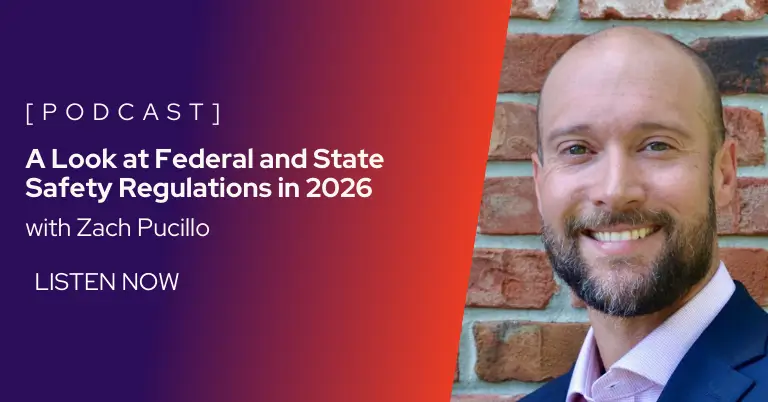
Today, we’re kicking off 2026 with our annual regulatory outlook. If you’re a regular listener, you know this is when we bring back Zach Pucillo, KPA’s EHS regulatory compliance manager, to look at what’s coming for workplace safety and compliance in the new year.
Zach is a certified safety professional and a certified hazardous materials manager who was recognized in 2022 by the Alliance of Hazardous Materials Professionals as Hazardous Materials Professional of the Year. He keeps his finger on the pulse of federal and state regulations, emerging technology, and industry trends, so he’s the perfect person to help us make sense of what 2026 has in store.
Last year around this time, we talked about the shift toward federal deregulation and the proposed heat rule, state-led regulatory action, and how AI and automation were starting to reshape workforce safety. A lot has happened since then, so today we’re checking in on some of those predictions, looking at what actually materialized in 2025 and mapping out the regulatory landscape for the year ahead.
2025 turned out to be a pivotal year for EHS compliance. We saw the EPA propose rolling back greenhouse gas reporting requirements, presidential proclamations granting facility-specific regulatory relief, and a government shutdown that slowed federal rulemaking to a crawl. Meanwhile, states didn’t wait around. They moved forward with their own standards that concerned everything from heat illness prevention to workplace violence to AI governance. For safety professionals, this created a complex environment. Less federal activity doesn’t necessarily mean less regulation. It means navigating a patchwork of state requirements. Add in a rapidly evolving technology like AI-powered safety tools and smart enforcement systems, and it’s clear that staying ahead of compliance in 2026 requires a different playbook than it did just a few years ago.
So, today we’re going to unpack what actually happened in 2025, what carried over into this year, and, most importantly, what safety managers should be prioritizing right now to stay ahead of the curve. Zach, welcome back.
Thank you for having me, Kat. Always a pleasure to speak with you.
Last January, you predicted that we’d see some significant federal deregulations with states like California and Washington stepping in to fill those gaps. Now that we’re a year in, what actually happened in 2025, and what surprised you most about how things played out?
So, yeah, last year around this time I had predicted we’d see some federal deregulation and we’d see some states stepping up to fill some of those gaps, and I think a lot of that did happen in 2025. But the way it unfolded was, I think, a little bit more intentional than I expected. So at the federal level, deregulation wasn’t just broad messaging. OSHA actually went into action pretty quickly. They proposed rolling back and rescinding about 25 different existing regulations. Many of them had been sitting on the books for decades and had no real enforcement value. I mean, some of them were just old policies like one about marine yards and open burning pits for fires for employees to keep warm. Those were banned in the past for safety reasons, but with today’s technology, that’s not even an issue that needs to be a regulation.
So OSHA moved to eliminate and simplify some things, like outdated record-keeping duplication and ancient construction standards. One I thought was a bit odd, though, was an illumination standard for construction sites that they’re proposing to deregulate. I’m not so sure that I would rescind a rule that you need to have a construction site illuminated. I do think it’s common sense, but we want to make sure appropriate lighting is going on there. There were also a lot around respiratory protection as well, changing some of the different PEL standards for using respirators with certain chemicals. Also, some consensus standard references that the industry always follows in other regulations, such as color code standards. We duplicate some of those in some of the regulations, like the safety orange or the warning yellows, and those were duplicated in different spots, so they kind of rolled back some of those.
The White House administration, though—keep this in mind, which I think is interesting about the whole 25 rule deregulation proposal—is the executive order from the President that for every one new rule that you want to create and enforce, you have to deregulate 10 others. So that requires agencies to remove 10 federal rules before issuing a new one. And I think that may be a part of OSHA’s strategy with those 25 proposed rules.
Another one that just came to mind was the actual proposal for the general duty clause. It basically will not be used in a citation where an employee is taking on an inherent risk. And so you kind of have to define what is an inherent risk. If the employees are subjecting themselves to hazards where they obviously know they could become hurt, then is it OSHA’s duty to protect them at that point and go after the employer? Such as, we’re talking about maybe like the entertainment industry. I’ll just use like a Cirque du Soleil show for example. You have all the acrobats jumping everywhere. That’s an inherent risk they’re mostly taking on where they want to do these death-defying abilities and showcase those for the sake of entertainment. Well, you’re taking on an inherent risk of that employment stature that you could get injured on the job at that point. So how much is it on the employer to actually protect the employee? Same thing for like sports and all of that, because what you’re doing as a professional athlete, you’re taking on a risk of potentially becoming harmed, and therefore, it’s not really something that OSHA should step in and create a citation based off the general duty clause for.
I’ve never seen it happen, but it’s possible that it could happen. And I think where they got this from was there was an animal trainer that unfortunately something happened with the trainer and the trainer lost their life and then it came back as an OSHA case. Well, you know, you’re taking on a pretty big risk working with wild animals. I mean, we should take all the precautions that we should, but there is always going to be that risk there. We’re also seeing different proposed rules, and it takes a while for those to actually get the traction to get through either the rule-making process or something slows it down such as you have different agencies lobbying against the rule for certain reasons. And I think like the heat illness rule, which I’m sure we’ll talk about here in a little bit, still hasn’t really moved on that front.
But we’re seeing states step up, as you did ask. California is the one I always keep my eye on. There are some greenhouse gas initiatives that were rolled back by the federal government, and California is pushing their way through with making sure that they are ready on the state side to require industry to report on their greenhouse gas emissions. They came out with Senate Bill 253 and 261, which is really about the greenhouse gas rules, and if you have over a certain amount of revenue and operate in California—it doesn’t mean your headquarters have to be in California, but if you operate in California and I believe it’s you do over a billion dollars in revenue, then you’re subjected to the greenhouse gas reporting requirements for California and then you also have to come up with a financial plan to show what you’re doing to try to lower those emissions as well.
California also has another senate bill out there as well too on the labor code side where training needs to be documented for record-keeping expectations so that if there’s a former employee that comes back to you and wants to grab their training records for some reason, maybe to impress a future employer or something like that, show that they have been trained in some of those categories, then the former employer needs to have that training record available for that employee to hand over to them showing them the courses that they’ve taken and a little bit of a description about what it was. It’s on the employer to make sure that they’re retaining that documentation for that employee even after they have left. So instead of less regulation, I think what we’re seeing is a redistribution of responsibility, so fewer federal rules on paper, maybe a stronger state-level expectation as we kind of move forward with the goal of the federal government trying to push the responsibility of environmental health and safety back on the states.
And I think that is something you touched on when we talked about this in June and then at the beginning of last year, was that a lot of it did seem to be switching from regulatory oversight to more state-led oversight. So let’s talk more about those big federal moves that we saw in 2025. I know the EPA proposed greenhouse gas reporting rollbacks and those presidential proclamations granting facility-specific exemptions, and then also the government shutdown that affected some regulatory activity. What are the current status of these initiatives and what are we carrying forward into 2026?
Yeah, so with the greenhouse gas rollback back in July, the EPA made their official announcement, their new administrator Mr. Lee Zeldin made that announcement that they’re rolling back or trying to repeal the endangerment finding. So the endangerment finding is all the scientific studies that were out there that basically the conclusion was that greenhouse gas emissions do endanger public health and welfare. And so that was based off of a lot of different scientific research. Well, the EPA pretty much is trying to undermine that scientific research and saying that they’ve put their own studies into place and that the greenhouse gases are not a threat to the public and therefore, if we roll back the greenhouse gas emission standards, that makes it easier on the power plants to operate, they’re not going to put regulations on what they call tailpipe emissions. So making sure that the emissions coming out of the internal combustion engine isn’t contributing to the greenhouse gases, originally under the Biden administration they were trying to make sure by a certain date that all vehicles were converting over to either a hybrid model or completely electric vehicle model based off of tailpipe emissions. So it wasn’t like, we’re forcing you to go into EVs, the whole thought was you are going to have to get to a greenhouse gas emissions level of output from that tailpipe that is pretty much unattainable and therefore you’re going to have to make the switch to EVs.
So where are we at with all that now? Like I said, it’s a proposal to repeal that endangerment finding, so nothing is really completely done there yet. There’s fights that are going on back and forth with that. And since we’re going to have this administration in place for at least the next three years, as we’re just now one year into it, I think we are going to definitely see a repeal there because of who’s heading that up and their objectives of what they want to do this year. Now you still have like California that is pushing forward with that, and so I have a feeling from a federal standpoint they’re going to roll that back, from state standpoint they’re going to move forward with it. And I don’t know if the EPA wants to get into a fight with California or not, especially since the federal government is like, we’re taking a step back and states you figure it out. Therefore, I see California definitely moving on with it, and I do see a greenhouse gas emission standard going on there that is going to force power plants to definitely look into what they’re emitting out there and also maybe a rollback in the automotive industry to make sure that all vehicles are electric by a certain point.
So as we head into 2026, I mean we’ve got companies that are navigating a lot. There’s pressures from uncertainty, delayed federal action that’s going on. 2026 isn’t about chasing every regulatory headline that’s out there. You’ve got to really make a defensible decision and document why you chose certain controls or timelines. So companies should plan for continued uncertainty in 2026 I think is where I’m going with this. Even though we’ve seen some big federal headlines that are going on out there, I think we’re still in a state of even though the administration wants to move a point there’s still enough opposition out there within Congress to really try to delay those from actually going through.
So with this federal-state divergence continuing, which states should companies be watching most closely in 2026? Are there any emerging state-level regulations that are going to catch people off guard as they go into effect?
I think if you’re a multi-state employer, it’s really about watching states of California for one. I think that’s the one that everybody always needs to continue to watch. But also Washington, because Washington has such a great safety presence with their Department of Labor. They are on the forefront as well too about regulatory enforcement that is out there. They seem to be a little bit higher on the scales of regulatory enforcement with their own standards within their own Department of Labor code as well.
You know, another sleeper out there statewise to keep an eye on: Minnesota and Maine. And why do I say those? Right now they’re on the forefront with polyfluoroalkyl substances, otherwise known as PFAS. And I’m sure that you’ve probably heard that term over the past couple of years, and PFAS are the little microplastics that are produced from basically items to keep kind of water from penetrating something. So we’re talking like sprays you put on your cookware and all of that, waxes you may put on your car, there’s certain firefighting foams that are out there, food packaging as well—you don’t want your food sticking to the packaging and so they’re coated with a lot of that stuff. Well, these little microplastics they’re so tiny that they do break down but they don’t ever go away. They break down into these microplastics and then they go out into the environment, and you have bioaccumulation that happens from that. So through waste they get into grasses, the soil, the water, and then you have the animals that feed off of that or the aquatic section you have the fish that consume that just through basically the food chain. We consume too and through bioaccumulation we’re consuming those microplastics at the same time.
And so what are we going to do about that? So Minnesota and Maine are starting to take some action on the forefront to put some items in place that are really restricting what the water treatment plants are identifying when it comes to these microplastics within the water system. So the water treatment plants are going actually have standards that they go by, and guess what happens from there if the water treatment plant can’t get in control of that. Now we’ve got to go back to the manufacturers and producers of these plastics and start regulating them on that. So right now it starts with the water treatment plants. Can they get these to an acceptable level that’s not going to be harmful for humans, which I don’t even know if we understand what that level is yet, but something definitely to keep an eye on with those two states as well.
That’s some great insight and I think speaks a lot to the direction things have been headed in the last couple of years because, like you said, I think PFAS have been a huge area of focus for a lot of these agencies. And I think another thing that’s been a huge focus in the last couple of years, especially with climate change, has been heat. And I know the heat rule was a big question mark last year. Where did it end up and what does the landscape look like now for companies who are trying to protect workers from heat illness, whether that’s through the federal standard, state requirements, or their own initiatives?
Oh, the good old-fashioned heat illness rule. I say old-fashioned because it’s just been out there forever, I feel like. You talk about earlier I mentioned a long process to get a rule from proposed all the way to finalized. This one has definitely taken the long way around. And so the federal government has done what it can, but got to keep in mind that the federal government when they make a rule has to take in consideration all industries out there, all of their issues with this, and you know, the main industries we’re probably taking a look at would be in the agricultural section and also the construction section because they can’t really escape the sun in a lot of cases. So how do you go about making sure that you have a standard that can be adhered to and that can be enforced and ensure that you’re actually protecting the worker as well too?
So the heat rule did not finalize in 2025. It doesn’t mean any heat compliance is on hold, so OSHA still has a heat illness expectation set through the Heat National Emphasis Program. And so if you don’t already have a state plan in place, OSHA can actually levy citations based off of their national emphasis program. They’re just going to use the general duty clause to issue citations out there, and they just extended that emphasis program to April of next year.
Now you got to also take in consideration within your own state, you may have had rules adopted and that’s where we’re seeing a flurry of activity on the safety side, is adopting heat standards or proposing heat standards. So the current states that I am aware of that currently have heat adopted standards in place would be California, Oregon, Washington, Minnesota, Maryland, Nevada, and Colorado. Colorado is just on the kind of agricultural side and Minnesota is mainly on the indoor heat side. But where we saw a lot of activity, we had states that have proposed heat regulations as well too. That’s going to be Arizona, Massachusetts, New York, Illinois, New Jersey, Rhode Island, and New Mexico.
The interesting one that I saw out there was Nevada and Arizona. Nevada came out with a heat standard and it is in place now and it’s enforceable, but they didn’t have a trigger point for when heat policies kick in. So there’s not a temperature threshold. The other states put in thresholds such as like in California I think it’s 82 degrees on the heat index and now their policies kick in for heat illness prevention. When it comes to Nevada they didn’t put one in. And then on the Arizona side, which is on a proposed status, Arizona also put in a cold standard as well too and so you’ll have to activate policies when the temperature drops below a certain threshold. I think their heat standard is at 80 degrees or higher, the proposed cold standard was at 60 degrees Fahrenheit or lower. I don’t know where you live in the country, but for me, I live in the Midwest and 60 degrees is a pretty comfortable day for me. So I thought it kind of interesting. And I’m sure it’s Arizona nighttime with the desert kind of climate out there I’m sure it does drop down pretty cold, so protecting those workers is something that they’re looking to accomplish too.
And hey, when you’re acclimated to an Arizona summer, I think maybe 60 degrees does feel cold. Yeah. So now that we’ve talked about some of the areas that enforcement is ramping up in, let’s switch gears to a little bit of industry. So looking ahead at 2026, which industries should be bracing for the most significant regulatory compliance changes? I know we’ve talked in years before seeing construction, warehousing, EV-related things. Are those still the hotspots or are there others?
I think construction and warehousing are definitely still the frontrunners. They’re front and center. I mean construction they have their own even set of standards at this point. I mean I’m not really getting into some of the other offshoots of longshoring or mining, obviously those are hazards there and they have MSHA for that and OSHA has a different section out there for they. If we’re talking general industry versus construction, I mean construction’s always going to be up there just because of the nature of the hazards. You’re building something from scratch at that point with raw material for the most part, and you can even say that the same case for mining, I mean you’re taking raw material out of the earth, and so those standards are very much in place for reasons that, you know, a lot of fatalities can happen in those industries if something is not set correctly.
So construction’s always going to be there. Warehousing I still think is a frontrunner, they still have a national emphasis program going on. And like I said I don’t know where you live at but where I live at in the Midwest we’re seeing distribution centers pop up all over the place. And like we talked about last year online shopping and fulfillment of that online shopping within, you know, a certain number of days, like we’re all in this attitude right now of, oh I can order this online and it’s going to arrive same day or tomorrow. Like, you have to have distribution centers to fulfill that and they’ve got to be constantly moving and churning things all the time. And so that warehousing side of it obviously we’re seeing a lot of high injury rates there which is why OSHA put a national emphasis program in place for them because we’re talking 24-hour shifts, we’re talking constant movement, we’re talking heavy machinery moving around in those warehouses, we’re talking robotics as well too that people have to be understanding and keep clear of, lockout-tagout a big concern throughout all of that. So I think those are going to be up there.
Another thing to keep in mind, though, with the different industries and the manufacturing side of things. I don’t see it necessarily as being really an EHS regulatory perspective, but EHS resources issues I think are going to become an issue. And why do I say those? Tariffs kicking in. So the President is really big on putting those tariffs on the other countries for import-export. And so as those tariffs kick in, they’re being taxed on getting a lot of those parts from overseas, and so as those parts come in obviously the manufacturer’s paying for those and there’s going to be a little bit of a lag in that process because they’re going to have to pass that cost on to somebody, it’s going to go down the chain to the customer, but they’re going to have to eat that upfront at first. And therefore is your budget because of these new tariffs going to have the resources to actually implement what you want to do in environmental health and safety because if we’re paying more on taxes for tariffs coming in for the parts that are required to actually do the business they’re going to have to take investment money out elsewhere to try to appease that.
That makes sense. There’s just so much going on in those industries and advancements in technology that I can see how there needs to be updates around the regulations. So speaking of updates to technology, last year we talked a lot about AI emerging as a tool in safety, everything from camera systems that catch unsafe behavior to software that generates safety programs. What’s the reality check on AI in 2026? What’s actually delivering value versus what’s just still all AI hype?
Obviously we’re going through some fascination with AI and we’re starting to see people actually put that into the business world to make it work. We’re starting to definitely see it on the environmental health and safety side. So I attend a lot of trade shows in the safety field, National Safety Council and the ASSP and some of those, and so obviously we’re seeing vendors actually populate more AI solutions for the environmental health and safety expert in the field. We’re seeing maturity in the market. I don’t think we’re seeing maturity that the market has promised yet, though. I think it’s going to take time, like I think we’ll all be seeing like, oh AI’s going to take my job and it’s going to do everything for me. No, I think AI is still—it’s always going to be a tool. Still need people to actually drive that.
I think where it actually is going to deliver in the safety field are very specific use cases, though. For instance, analyzing like trends in inspection. If you can actually go through a certain audit reports—maybe you have 10 different audit reports and you want to look for a certain trend based off of pictures or based off of what are the average OSHA citations based off of this hazard that we keep finding within our organization. It may be able to go out there and publicly find that and you start to get actually a monetary data point that you can assess that hazard with at that point. I think standardizing an incident reports as well. I mean think about it, if you could take all of your incidents for the year, maybe they’re on a spreadsheet, maybe your OSHA 300 log or something like that, and you could have an AI tool take a look at that and say, I need you to analyze this, help me identify some root causes, because root cause analysis is not an easy process to go through for any safety professional. You know, there’s lots of different techniques out there, Five Whys, the Ishikawa fishbone diagram, failure mode effect analysis, there’s lots of different ways to go about it but they’re all very time consuming especially on larger incidents. So if you can have AI go through that and identify root causes for you, and then you can even have it go a step further such as give me the preventative playbook that I need to ensure that this doesn’t happen again as long as you’re following along with that, that could really be some great intel, gives you kind of a good working path to go down.
Documentation, organizing it, like every industry out there has like every business with the safety data sheet side of it probably has, you know, 100 to 500 safety data sheets that they’re managing. And let’s say that something comes up on the TSCA report where basically EPA announces this is a new toxic substance at this point. Well, what if you could easily go through all your SDSs with an AI tool scanning for that one particular chemical as an ingredient and it easily identifies that throughout all of your SDSs within a matter of, you know, few minutes. That’s a huge time saver right there. I know we’re looking even at that as an organization to maybe help us out with, you know, some different permitting activities or even from a PFAS standpoint can we identify what has a PFAS potentially in it.
And then there’s also the visual component of it as well, which I think is pretty cool. I haven’t really tested it out myself personally yet but now they are starting to use AI to build it into camera surveillance systems that are out there where the AI will actually watch an employee and it will identify an unsafe act and then that can report that or data log that and roll that up to EHS managers. So maybe it was like somebody left a box knife out with the blade open and exposed, could be somebody really used bad posture to pick up a box or something like that. It identifies those and then it gets to the EHS professional and then you have some coaching material that you can take to the employees to show, no we have a buddy-lift system for a reason or we have back braces for a reason, these are why we gone to these knives to make sure that you guys are always closing up the blade, we don’t want the risk here, so let’s make sure that we get these things taken care of.
For safety managers who are planning their 2026 strategy right now, what would you say are the three most important areas that they should be preparing for or investing in this year?
You know, I try to connect these with like what are OSHA’s new priorities. I think they have some pretty good priorities out there set for this administration. They just put in place a new OSHA administrator, his name is David Keeling, and he came out with his main priorities. So their priorities: improving regulatory oversight and rule-making, promoting collaboration, and transforming enforcement through technology. And as I think about those three, I first think about managing consistency and visibility across like all operations as an EHS professional. That’s probably one of the areas I would start at because that’s such a difficult task. So as you have organizations like OSHA working to modernize oversight and rule-making, enforcement’s becoming more data-driven and less site-specific. So that means as a safety leader you need systems that show consistent policies, training, inspection, corrective actions across every location. So if, you know, you have a regulator looking at your organization holistically, and you want a clear defensible story that looks the same everywhere.
The next one was collaboration and engagement, so I think that’s a very important from an EHS perspective to take a look at as well too. So OSHA’s been very clear about wanting more cooperation between employers, workers, unions, safety professionals. I think for managers that means moving beyond the top-down policies and investing in programs that really involve the employees. You know, the joint safety committees, the near-miss reporting, peer observation, actual meaningful training, not just checking a box in a lecture hall or something like that. You really got to build that culture and I think that’s what the regulators want to see and so that means to build a culture the employees have to be involved with collaboration.
And then the using technology to transform enforcement readiness. So as we lean into those predictive analytics that we were even just talking about on the whole AI side, I think safety teams need to take a look and doing the same. It doesn’t mean buying every new tool that comes out, it just means using technology to spot trends early. Prioritize the highest-risk tasks, document the decisions before a regulator even shows up. I think that organizations that use data proactively will be far better positioned than those reacting after an incident, so it’s really about being proactive and not being reactive. I think taking together the message for 2026 is clear. Don’t look for just compliance, try to build a mature system that shows foresight, consistency, and then involvement from all employees.
That makes sense. And setting up those places for employee buy-in or ways to enhance the culture, I think, can also go hand-in-hand with the ways that, you know, states are taking on more of this responsibility and it’s less on the federal government. So with potentially less federal oversight but hopefully not less commitment to safety, how should safety professionals think about their role in 2026? Is there anything that excites you or concerns you most as we look at the year ahead?
Yeah, I think we talked a little bit about this last year and we’re still at a period of trying to figure out the, I think we know the direction of the administration that’s in place and therefore kind of piggybacking off of that. I still think we’re entering one of the phases where the safety professional has become one of the more important key people within an organization. With the less federal oversight, I mean safety leaders can’t just be rule followers. They have to be risk managers and business partners. It can’t just be about citations, it can’t just be about we have to do this because the federal regulation or the state regulation says to check the box. No, it’s actually being a safety professional in the organization and thinking about the people first.
I think what excites me is that we can move faster than the regulations can. You know, the regulations are obviously very slow. So if you don’t have like a heat illness policy in place because the federal rule hasn’t come out, that doesn’t mean you can’t put one in now. That doesn’t mean we have to wait on whatever the issues with greenhouse gas reporting are going to fall out to be, we can still do and be proactive to be really trying to take care of what we set out to do in this profession in the first place, and that’s take care of the world, the environment, and take care of the people. We can adopt better tools, adopt better training, and better engagement without waiting for a rule.
Now what concerns me is complacency. And that’s, you know, don’t wait around for rules to come about, for the regulator to come about. The idea that fewer federal headlines means less risk, that’s no, that’s not the case at all, and I think everybody does understand that. We still have jobs to do to make sure that we’re protecting the people. So safety success is going to come down to ownership. Companies that operationalize safety, they’re going to thrive regardless of whatever the regulations do next.
Right. And I think that that’s a great summary and a great way to kind of think about stepping into the next year is making those plans, thinking about your team, not necessarily worried about checking a box or making sure that you’re up to date on the latest things that are coming down from whoever, but just keeping your team safe. If you take that first step and that’s what you’re concerned with, then I think everything else can follow along.
I agree 100%. It really comes down to us and being leaders and really thinking ahead about where you want, what, paint a picture. What do you want that picture to look like for your own position, for your organization? And are you there now? Probably not. Can you get there in the next couple of years? Probably so. What do you need to actually do to get there? And that’s what you need to jot down and put down as your main goals.
Perfect. Thank you so much Zach, it’s always great to talk to you and get your insight on all of the things that are happening out in the field. Your expertise is invaluable to our listeners. So thanks again for joining us to share what your thoughts are for 2026.
Always a pleasure. Thank you so much for having me.