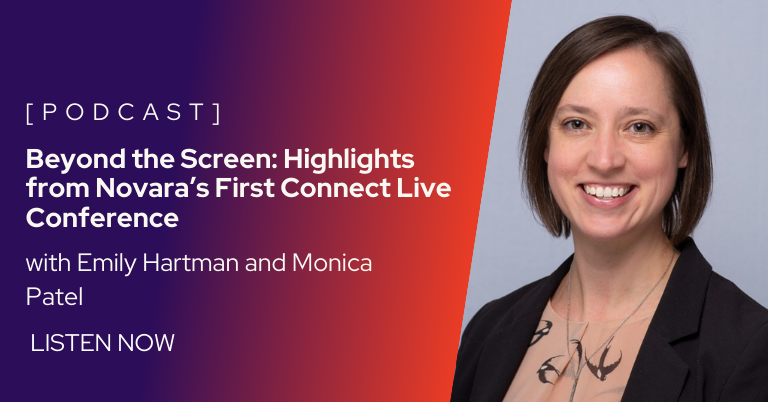
We’re doing something a little bit different today; we’re recapping Novara’s Connect Live conference, where hundreds of Flex users came together in Dallas this October to level up their skills, connect with peers, and get an exclusive look at what’s coming next for the platform.
If you’ve ever wondered what it’s like when a user community moves from online forums to face-to-face collaboration, or if you’re curious about the cutting-edge ways that safety professionals are using technology to transform their safety programs, this episode is for you. I’ll be joined by two people who are right in the thick of it. Emily Hartman, who leads our Novara online user community, and Monica Patel, software product manager at Novara, have led multiple sessions on a range of topics, from admin tools to API integrations. Thanks for being here, guys.
Monica:
Thanks for having us.
Emily:
Thanks.
As I mentioned, Emily Hartman is the community manager of Novara’s Flex user community, where she moderates forums, sparks conversations between users, and recognizes standout contributors. Emily played a key role in bringing Connect Live to life by identifying topics that matter most to the community and connecting users to become speakers and panelists at the event.
Monica Patel is the software product manager at Novara, bringing a strong background in engineering and operations with hands-on experience across energy, technology, and logistics industries. Monica’s expertise lies in leveraging technology to tackle complex safety and compliance challenges, making her a driving force behind Novara Flex. Her passion for enhancing operational efficiency and safety standards is reflected in her commitment to helping businesses integrate innovative solutions into their safety programs.
Let’s jump into the questions. Emily, I wanted to start with you. This was Novara’s first user conference for Flex. For people who weren’t there, can you paint a picture of what Connect Live was like? What was the energy in the room those days?
Emily:
Yeah, happy to. Honestly, I’d say the energy was overwhelmingly positive and collaborative. I think it brought the same welcoming and supportive energy of our online community, but with that magical sort of electric feeling you only get when a bunch of really passionate people are together in the same place.
And just to give you an idea of what it was like, we basically had a hotel and meeting space dedicated to the conference, so everybody was just in one area. And then in addition to having the meeting rooms for breakouts and general sessions, we use the meeting area lobby space to feature our partners. We had our training team demoing some really cool new VR technology that they’ve been working on, and we also used that space for happy hour and some general networking sessions. We also brought Connect’s Game of Occasion to life with the conference. We had a scavenger hunt that people got really into. Shout out to our winner and all around good sport, Grace Quintero.
And honestly, we really didn’t anticipate just how many people were going to come. We were thinking maybe about 100 people, and we ended up with around 200 people. So I feel like for next year, whatever it is we plan on doing, we’re going to plan on something that’s going to be bigger and better than this year.
It’s so cool to hear about all of the excitement in the room and the fact that it generated so much more attendance than we were expecting. I remember those goals being set at 100 and us surpassing them within a couple weeks of the invite being open. So it’s so cool to see that people that use our software are not only engaged in these online communities where they talk about how they use it and collaborate in those ways, but when they see an opportunity to have to travel, but to be able to be live in person, that so many people say, “Yes, please, I want to be there.”
So that brings me into my next question. You manage the online community day-to-day, so you’re constantly seeing what users are asking about, what they’re struggling with, what they’re celebrating. How do you take that pulse of the community and translate it into some of the programming that was there for Connect Live?
Emily:
I mean, honestly, I think Connect is our north star. And the idea for the user conference actually started within the community. I remember when we first launched Connect to one of our community members, Bill Woods, started a discussion about wanting to have a user conference, and it got a ton of votes, it got some chatter, and it was our first real sign that we knew we would have to figure out how to make something like this happen. I mean, it took us a couple of years to get here, but I’m so glad that we finally did because it really was just bringing the online community into real life. The energy and the vibe was just amazing.
I think the other thing is when you’re in Connect every day, you start to see patterns, and some of the same questions will pop up time and again, you’ll see the same aha moments when someone shares a workaround for a problem, and some of the same frustrations that can sometimes arise on trying to solve for an issue. Often, we see questions about workflows, forms, equipment, and training. And that’s why I think for this very first conference, we wanted to create an experience for learning and almost like a level setting for everyone that focused on Flex’s features, where it didn’t really matter if you were a new user or somebody who’d been using Flex for the better part of a decade. I think we struck a good balance there.
And in fact, when we asked people afterwards if they had taken away some good ideas, pretty much everyone, 98% of our survey respondents, left with actionable ideas that they plan to implement immediately.
And I think the other thing we wanted to do is create the same environment of friendliness and casualness that we have in Connect, so that people feel like they have the chance to talk with each other. And I think what we heard from them is that they felt we struck a good balance between session time, learning time, networking, and collaborating with each other, as well as meeting Novaraers. So I think we had a good success rate. I think next year, we’ll do some more fun things with folks to build on everything we established this year.
You mentioning people walking away with new ideas for things, I think, really hit a chord with a lot of people because I saw there were some videos that were put out on our LinkedIn that were man-on-the-street style that we were going around and saying, “What’s a new thing you learned at the Flex conference that you didn’t know Flex could do?” And there were so many people who were blown away by things that they had no idea that it could do and would simplify their workday.
So I can see how it generated a lot of excitement and can also help people to utilize what they already have to a greater extent. I think there are probably ways that our users are unaware of, which could be improved by using Flex instead of a disparate system or paper-based processes they currently employ. So the community is obviously active online year-round. I know you’re always fielding these questions about how to do this and what about that thing, and all that stuff. So, is there anything different about being in person? What happened at Connect Live that maybe couldn’t have happened in a forum thread or in a webinar?
Emily:
Oh, my gosh, yes, so much. The online community is powerful for solving problems, but in person, there’s no substitute for that. You can’t beat seeing people face-to-face, getting the chance to build relationships with them, creating trust, and having those on-the-fly conversations that change how you think about the work, how you’re using Flex, and the ways you’re using Flex.
And you mentioned it earlier; one of the things I got to do, which was really awesome, was creating some of those videos that we put out on social media, asking people what they were learning and enjoying, and what their experience had been like. And the other thing I heard the most about was the networking and collaborating in person; it really is next level. You can’t really beat the fact that you are sitting at a table and you overhear someone at another table talking about something, and you’re like, “Wait, that’s what you’re doing?” That’s just that organic magic that you just can’t get from being online all the time.
That makes a lot of sense, because in terms of that online forum, I’m sure people are going there. I know you prompt some questions sometimes, but I’m sure the majority of people that are heading over to the forum are to say like, “Hey, I had a question about this thing,” or, “I’m trying to do this,” or, “How have other people done this?” However, when these conversations occur in close proximity to each other, people can gain insights that they wouldn’t have gained if they hadn’t asked that question. It didn’t even occur to them. So I can see how that can create a lot more kinetic connections and conversations in that way.
And speaking of that, Monica, I know you led several sessions at Connect Live, everything from admin tools to API integrations to hidden gems in the platform. Can you tell us about a common thread that you noticed across these different sessions, or maybe what people were most hungry to learn in your sessions?
Monica:
Let me first say that I completely agree with everything Emily said about the vibe and atmosphere during the user conference. I have to tell you, I watched all of the Steve Jobs product launches to prepare for our very first user conference. Those are all online. And I walked into the user conference thinking, “Okay, it’s not going to be like that. We’re not Apple.” But it actually felt like that because our software helps people, and they’re just so excited to talk to each other about the problems that they’re solving with the software.
So, going back to your question on the common thread in some of the sessions that I led, I think the number one most common thread was that people wanted to hear from each other. They wanted to hear about it, just as Emily had said, to see how you were solving the problem on your side of the fence and whether it would help them solve their very specific issues. So it’s one thing to showcase the software and show people, talk about specific use cases. It was another thing when people were talking to each other in the room. I think that was extremely valuable for the participants and was a common theme in every session I led.
I know I’ve heard many people online and in other spaces, including LinkedIn, posting their experiences from the conference, and I don’t think I’ve seen anything less than a glowing review. I’m sure it’s incredibly cool to be on that stage and to empower people to make these changes or improve their workdays. I’m sure they appreciate it very much.
Speaking of things that make people’s workday better and perhaps things they didn’t know about, I’d really love to talk a little bit more about the Hidden Gems sessions, specifically. I find that title really intriguing. What are some of the features that are hiding in plain sight that people are not taking advantage of yet?
Monica:
Our core features with the platform include digitized forms and workflows, which solve a lot of people’s problems. However, there are definitely some features that are far less widely known but offer a huge bang for the buck when utilized appropriately.
So, the ones we went through during the session were acknowledgments. For those of you listening who haven’t used acknowledgments, acknowledgments are a way for you to communicate with your user base, letting people know if, for example, there’s an issue on the site, and you can see who has signed off on that acknowledgment. So, really nifty tool.
New hire evaluations, which we provide within our software, are definitely underutilized. Consider how many people you employ and what their 30-, 60-, and 90-day evaluations should entail. You can put all that into Flex and automate some of those processes, workflows, and tasks.
And then the last one that we addressed in that session, which is my favorite, is question of the day. Now, question of the day is, it’s only a feature if you utilize the training portion of our platform, but it’s a way for you to quiz your workforce without it actually feeling like a quiz. It’s meant to be like a quick 30-second can you answer this question? And there’s a leaderboard, a scoreboard for your user base to see where they rank among all your other users. It’s a fun way to encourage participation within your platform.
Okay. And if you’re a regular listener of this show, you know that we’ve talked many times about bite-sized training, about gamification, about making it something that people are excited for. I know that you also had a session on APIs and integrations, which sounds pretty technical. I know if I were at the conference and I saw APIs and integrations, I’d be like, “That’s not for me. I don’t know what I’m doing there.” However, I can imagine that the conversation could also be more about how integrations can unlock various benefits for your safety program. So, can we discuss the real-world examples that customers shared and how they’re integrating Flex with other systems?
Monica:
Yeah, definitely. So you’re right, people hear APIs and integration, and they think, “Oh, wow, that’s very technical.” I can share with you that I don’t define myself as a very technical person, but the session was really great because we definitely had that back-and-forth with customers, sharing how they’re currently utilizing the API to help others in the room who maybe haven’t started yet.
Some of the examples included a customer who utilizes the APIs for a scorecard for their users. They have a driver qualification system that they’re utilizing that is outside of Flex. They utilize Flex for their digitized forms. And using the APIs, they were combining all of that data within Power BI to create a scorecard for their users to review and determine if they were green, meaning they had completed all of their forms and qualification items, and were ready to proceed. Or, if they are red, meaning some items are missing for them, that individual explained that the gamification, as we’ve been discussing, really drives participation for them. So that was a really cool example.
We had another instance where a construction company was trying to reduce the administrative requirements for the numerous projects they are currently working on. He was able to share with us that they were utilizing APIs to reduce administrative work, creating automations where Flex was the source of information, but we could also send it directly to their ERP solution. But yeah, APIs, they seem really scary, but they don’t really need to be. I was extremely happy with that session, and we received some outstanding participation from our customers.
I love hearing that. And it’s also interesting, because APIs are so open-ended, to learn about the different ways customers are integrating them into their systems or the creative ideas they’ve come up with. Because I’m sure when that was announced, and I’m sure there were a lot of oohs and aahs from the … “Ooh, wow, oh, we can do that. Hmm, how fun.” I wanted to address a couple of questions that I think might be relevant to both of you. Feel free to jump in, either of you.
One thing I noticed across the sessions was the theme of moving from basic to advanced, such as form-building boot camps for beginners or mission control for those looking to elevate their admin skills. I’m sure that many Flex users who were there are probably more advanced, but when it comes to most of our Flex users, where do you see them sitting on the spectrum, and what does growth look like? How do they get from basic to advanced?
Monica:
Yeah, so I’ll go first. I believe we had users at the conference from all parts of the spectrum. I think you’re right, Kat, that they leaned a little heavier on, I’m going to say, middle to more advanced in some of the things that they were doing, but it was nice for us to have that full spectrum. We even had some prospects attend as well, so they were really coming from zero.
And growth, to me, means figuring out different ways to utilize the platform that weren’t originally thought through for all our users. We have a highly configurable platform that can do a lot, but you don’t know what you don’t know until someone tells you how they’re using it, or someone makes a comment, and then the gears start turning. Growth, to me, is exactly what it is for our users.
Emily:
And I feel like I’m just going to echo everything that Monica just said. I feel that the growth was evident, as the attendees were mostly in the middle to more advanced stages. And one of the real takeaways that we took from that, I talked a little earlier about how we wanted it to be a level setting because we weren’t sure what we were going to get, the type of folks who’d be interested in this, and that’s why we created an experience that was maybe for folks who were both new or more advanced.
But I think the takeaway and the feedback that we received, the growth is really going to … for at least Connect and user conference, perhaps for next year, is like, where do we go from here in terms of creating more in-depth interactive sessions and more learning environments for people to really dig into the software? I think we can build on the idea that you don’t know what you don’t know, and hopefully, we can create experiences that allow people to chip away at this by seeing what others are doing and learning from each other.
And I’m sure anyone listening who has learned any sort of software, when you’re going through these tutorials at the beginning or you’re onboarding, you get so much information and you’re told all of these different things that things can do, but until you’re using the software, I feel like all that just goes right out, right out of your brain. Because I’m sure there are so many times where people go, “What? You can do that?” And maybe they did learn it during their onboarding, but it’s so hard to hold onto that when you’re not actively using the platform at that time. And so I can see how, after however many years of using the platform, you’re still finding those surprises.
So, for someone who’s listening, who manages a safety program but maybe uses a different software or is still doing things manually, either entirely manually or partially manually, what would you want them to know about what’s possible when you have the right tools and an active user community behind those tools?
Emily:
I mean, this feels like the perfect plug for the community and everything that we do there where it’s like we do weekly challenges, but they’re activities that are very specific to software tips and tricks, and we are constantly looking for different ways to remind people or show people how to use the software maybe in ways that they have not thought of or more as a refresher, as they forgot to do this. We have one that I always like, which is uploading a PowerPoint presentation as a training course into the system, and little things like that that you can do.
To me, that’s what the community is for: to provide continuing education and support. Even if you don’t see it on the day you go in, you can ask a question, and someone will get back to you.
I can see how those things are super important and having that participation or just understanding that you have something to fall back on if you have a question or maybe support’s closed for the day or you just want a noodle on a new idea, having that community behind it of people that not only use the software, but are using the community to help others. Because I’m sure there are listeners out there who have used software that is frustrating, and they find that when they go into the community, it’s filled with numerous complaints. It’s extremely powerful to have a base that loves the software and wants to help others use it effectively.
So looking ahead, what are you both most excited about based on what you heard and saw at Connect Live? Can we give a little sneak peek at maybe what’s next for the community and the platform?
Emily:
I think for me, it’s more of what I was talking about earlier where it’s providing a deeper and more well-rounded experience for our users to learn from each other, whether that’s like hosting a workshop where everybody tackles a project or something that they have already voted on that they’re going to be working together on like a hackathon, or if it is at the next Connect Live, we figure out ways for people to work together on something in real life versus doing that through the online community.
I mean, I think the other thing that’s really cool, and maybe this is helping to tee up Monica, but the other great thing about Connect Live was the fact that our customers had, in real time, access to Novara folks and getting to talk to Monica and Jade about some of the product ideas and things that they have. It’s a great source of information, and we do that on the platform and in the community all year long. There’s always more that we can build on to help customers and solve their problems.
Monica:
Yeah, you’re totally right, Emily. It was incredibly nice to be fully present and focus on someone’s individual issue, idea, or problem, giving them my undivided attention. So that was really cool.
I think from my perspective, what excited me the most about Connect Live, two things: our CAB, our customer advisory board, at Connect Live, actually, we asked our participants to apply to be in our CAB, which is something that we’ve never done before, and there were so many applicants, and they were so much fun to read. I’m extremely excited about the group we’ve selected to move forward with. Our first meeting is scheduled for December, so I’m looking forward to it.
And then the second thing, which is really similar, is we asked the room for beta testers for some upcoming feature releases that are going to be huge for us in the next couple of months. We had a lot of handraisers for that too, which lets me know as a product manager that we’re prioritizing and releasing the correct things because there was so much excitement over them. So yeah, those were my two items that I’m super excited about moving forward with.
I love that. It’s so cool to hear that we actually have a board of customers that we want to put together to say, “What do you guys need, and what can we do for you?”
That’s all the questions that I had for you guys. I think this was an incredible look at Connect Live and how we are not only empowering our customers to talk to each other and help each other, but get together and learn from each other. And I cannot wait for next year. Thank you so much for being here with us today, guys. It’s always great to talk to you both.
Related Content
Explore more comprehensive articles, specialized guides, and insightful interviews selected, offering fresh insights, data-driven analysis, and expert perspectives.