From Clipboards to Zero Recordables: How Monterey Mechanical Transformed Safety with Mobile Technology

The Paper Problem No One Talks About
Every safety professional knows the drill. A worker spots a hazard on a job site, jots it down on a clipboard, and hopes the form makes it back to the office before the end of the week. By the time leadership sees the report—if they see it at all—the hazard has either been forgotten or become something far worse.
For organizations operating in high-risk environments like construction, heavy industry, and infrastructure, this delay isn’t inconvenient. It’s dangerous.
Paper-based safety systems create blind spots. They introduce lag between observation and action. And they place an enormous administrative burden on safety teams already stretched thin across multiple job sites, shifting crews, and evolving regulatory requirements.This article is part of our Game Changers series, featuring organizations that are redefining what’s possible in workplace safety. Monterey Mechanical was named the Safety Culture Champion at Connect Live 2025, recognized for achieving exceptional safety performance while more than doubling their operations.Monterey Mechanical, a California-based mechanical contractor specializing in water infrastructure, heavy industrial construction, and large-scale projects, knew this problem well. Their crews work daily in confined spaces, on elevated platforms, and around heavy equipment—environments where a single missed hazard has serious consequences.
What they discovered was how dramatically the right technology transforms outcomes.
A Philosophy Called “Beyond Zero”
At Monterey Mechanical, safety isn’t a compliance checkbox. Leadership treats it as a core value woven into every aspect of operations.
The company’s guiding belief: every incident is preventable. But their philosophy goes further than chasing a number. In workforce safety, Beyond Zero moves past viewing safety as a numerical target of “zero incidents” and instead treats it as a proactive Culture of Caring. While “Zero” aims for no injuries, Beyond Zero focuses on the presence of positive behaviors, employee well-being, and community impact.
For Monterey Mechanical, zero incidents isn’t a finish line—it’s the foundation. Safety means not only preventing harm but fostering engagement, ownership, and continuous improvement across every level of the organization. It means celebrating the behaviors that keep people safe, not just counting the incidents that don’t happen.
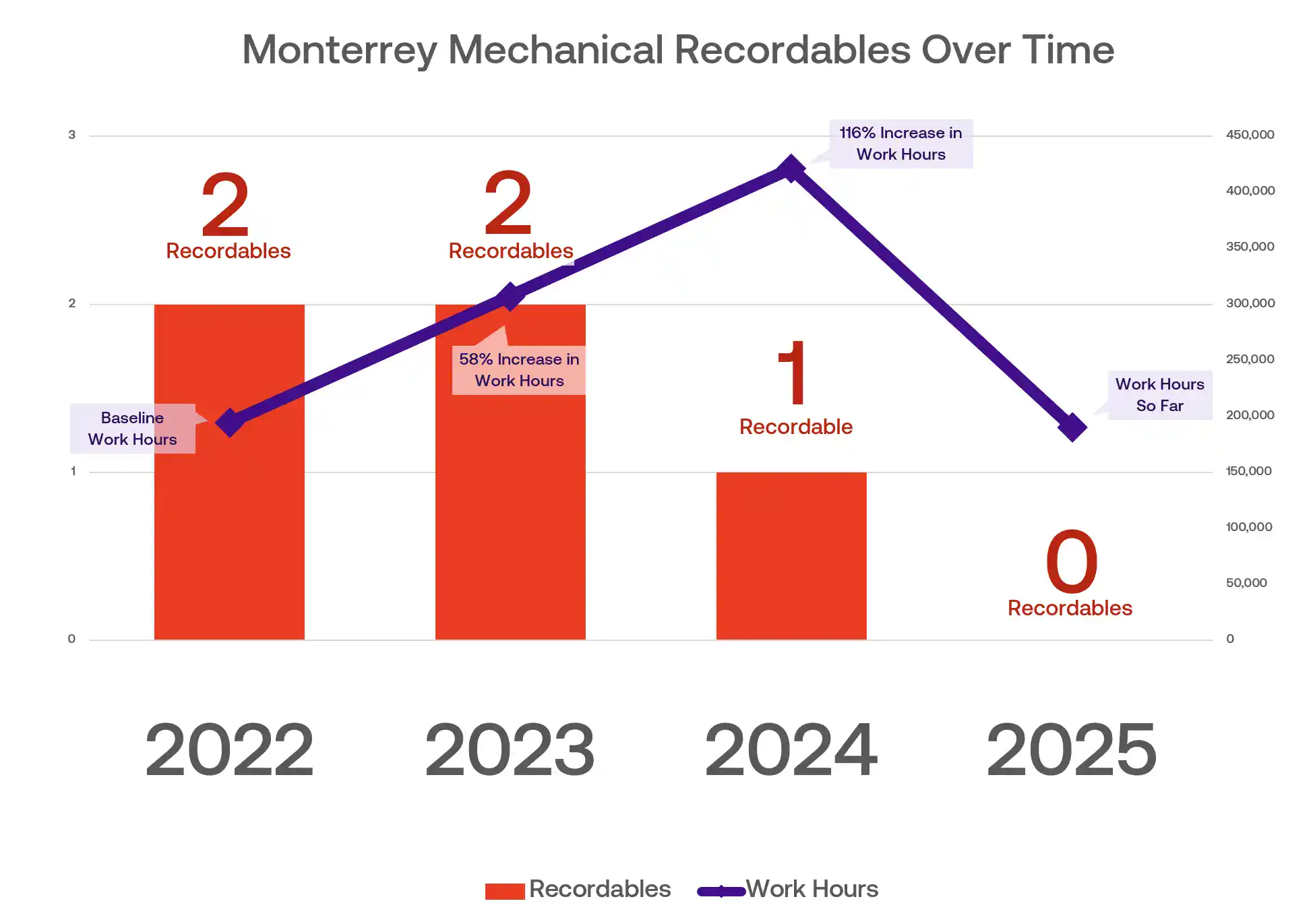
This philosophy sounds aspirational. But Monterey Mechanical has the numbers to back it up—and it’s exactly why they were named Safety Culture Champion at Connect Live 2025.In 2022, the company recorded two injuries across the hundreds of thousands of work hours. In 2023, despite a 58% increase in hours worked, they maintained just two recordables. By 2024, with another 37% growth, recordable injuries dropped to one.
And in 2025? Zero recordable injuries at the time of reporting.
The company didn’t just maintain safety during rapid growth. They improved it.
The Turning Point: From Manual Systems to Mobile-First
The catalyst for this transformation: implementing Novara’s operational risk management platform—a mobile-first system designed to digitize safety reporting, pre-task planning, inspections, and training verification.
Before Novara, Monterey Mechanical relied on traditional methods that made consistent oversight across multiple job sites impossible. Documentation was fragmented. Training records lived in filing cabinets. Near-miss reports arrived days late—or never arrived at all.
Like any new system, Novara required an adjustment period. But the platform’s intuitive design meant that with continuous use, it quickly became second nature. Today, workers have everything—forms, training records, SDSs—in one place rather than scattered across multiple platforms.
“Novara is easy to navigate and user-friendly,” notes one team member. “It doesn’t require cellular service to create work plans or inspection forms. Documents can be adjusted and updated throughout the workday.”
This accessibility proved critical. When safety tools are intuitive enough for field workers to use in the moment—not back at the office—participation increases. And participation is where culture change begins.
Real-Time Visibility Changes Everything
The most significant shift wasn’t technological. It was behavioral.
With Novara’s mobile tools, Monterey Mechanical’s crews document hazards the instant they spot them. A worker opens the app, captures a photo, completes a customizable incident form, and submits the report in real time. The safety manager receives an instant notification. A corrective action is assigned through an automated workflow. The worker receives acknowledgment and an action plan.
The entire loop—from hazard identification to resolution—happens in hours instead of days.
Workers now feel empowered to stop unsafe work without fear of reprisal. This cultural shift has driven higher rates of reporting minor incidents and near misses, enabling leadership to address risks before they escalate.
This shift from reactive to proactive safety represents what operational risk management should accomplish: identifying and resolving issues before they become incidents.
For Monterey Mechanical’s leadership, the dashboards and analytics built into Novara surface patterns, high-risk activities, and emerging trends in real time. Supervisors prioritize interventions based on data rather than intuition. And because every report is timestamped and documented, compliance audits that once consumed days now take hours.
The Business Case for Mobile Safety
Safety transformation isn’t only about protecting people—though that alone justifies the investment. It’s about operational efficiency, regulatory confidence, and financial performance.
Monterey Mechanical’s experience illustrates all three.
Administrative burden dropped significantly. Field crews add entire teams to a pre-task plan in seconds, update documents in real time, and access training records, SDSs, and compliance documentation from one platform. The hours previously spent on paperwork are now redirected toward actual safety work.
Compliance confidence increased. With centralized data, time-stamped submissions, and automatic notifications for inspections and corrective actions, Monterey Mechanical approaches audits with documentation that’s complete, accessible, and defensible.
Insurance and liability exposure improved. Fewer incidents mean lower workers’ compensation claims, reduced EMod rates, and stronger positioning during contract negotiations with clients who prioritize safety performance.
The platform scaled with the company’s growth. Novara’s configurability enabled Monterey Mechanical to build custom workflows, forms, and reporting structures that matched their specific operations—without costly professional services or code changes.
As Monterey Mechanical’s leadership reflects, the creative application of the platform is not in its technology alone, but in how it’s woven into the company culture—supporting employee recognition programs, celebrating milestones, and reinforcing the right to stop work without reprisal.
What Zero Recordables Actually Means
Achieving zero recordables in a calendar year is a significant milestone for any organization. For a contractor operating in high-risk industrial environments—while more than doubling work hours over three years—it’s the kind of performance that earns industry recognition, including the Safety Culture Champion award.
But Monterey Mechanical’s leadership team doesn’t treat it as an endpoint.
The Beyond Zero philosophy means constantly asking what else is possible. It means treating near-miss reports not as failures but as opportunities to prevent the next serious incident. It means measuring success not just by the absence of injuries, but by the presence of positive safety behaviors and genuine care for employee well-being. It means building a culture where every worker feels ownership over safety outcomes.
Technology alone doesn’t create this culture. But the right technology—intuitive, mobile-first, and configured to how work actually happens—removes the friction that keeps good intentions from becoming consistent action.
For Monterey Mechanical, that technology is Novara.
Is Your Organization Ready for Mobile Safety?
The gap between paper-based safety systems and mobile-first platforms isn’t measured in features. It’s measured in response time, participation rates, and incidents prevented.
If your organization still relies on clipboards, delayed reports, and fragmented documentation, the question isn’t whether to modernize. It’s how quickly you can make the transition—and whether your current approach can scale with your growth.