Safety Committee Best Practices: 4 Tips to Keep Yours Running Well
Safety committees don’t fail because people don’t care. They fail because there’s no structure underneath them — no agenda, no accountability, no documentation that survives a committee member turnover.
If your committee has been running on good intentions alone, here are four practical habits that will make it more effective.
Safety Committees are one of the 4 Pieces of an Audit and Inspection Program.
Tip 1: Know What Your State Requires
Depending on where you operate, your safety committee may be legally required — or not. Some states mandate them for employers above a certain size. Others require a specific ratio of management to non-management members, a minimum meeting frequency, or documentation you’ll need to keep on file.
Look this up before you design your committee structure. Building something that doesn’t meet your state’s requirements means rebuilding it later — which is a frustrating use of everyone’s time.
Does Your State Require a Safety Committee?
Requirements vary by state, employer size, and industry. Know what applies before you build your committee structure. Hover over any state for details.
Tip 2: Document the Committee’s Structure and Purpose
A safety committee without documentation is just a recurring meeting. Documentation is what gives your committee continuity — especially when members rotate, and they will.
At a minimum, your committee should have a written charter covering its purpose, membership guidelines, and meeting cadence. From there, document your standard agenda, how action items get tracked, and how decisions get made. If the answer to any of those questions lives only in someone’s head, that’s a gap worth closing.
Your documentation should also define the committee’s scope. What does it review? What can it recommend? What gets escalated to leadership? Clear boundaries keep the committee focused on what it can actually change.
Needs in Writing
- Committee purpose & authority
- Membership criteria & rotation
- Meeting cadence & quorum
- Topics and time allocations
- Who presents each item
- Decisions needed in the room
- Item description & source
- Assigned owner (one person)
- Due date & completion status
- What the committee reviews
- What it can recommend
- What escalates to leadership
Tip 3: Send the Agenda Before Every Meeting
Distributing the agenda in advance — even just 24 hours ahead — changes the quality of the conversation. Members come prepared. Topics get discussed instead of introduced. Decisions that should take 10 minutes actually take 10 minutes.
A good agenda names the topics, identifies who’s presenting or reporting on each, and flags any decisions that need to be made in the room. It also gives quieter members time to think before they’re expected to speak — which tends to surface better input from people who don’t naturally dominate a discussion.
Meetings without agendas have a way of ending with everyone unclear on what just happened. Don’t let that be your committee.
Tip 4: Assign Every Action Item to a Specific Person
This is where most safety committees lose momentum. An action item with no name attached isn’t an action item — it’s a note. Notes don’t get done.
When something comes out of your committee meeting that needs to happen, put a name and a deadline next to it. Not “the committee will follow up” — a specific person. And it doesn’t need to default to the safety manager every time. Committee members from operations, maintenance, or HR can own items in their areas. That’s also how you build real buy-in: when people own an item, they have a reason to care whether it happens.
Follow up on open items at the start of every meeting. If the same item rolls over for three consecutive meetings, that’s a signal — either the item needs to be broken down differently, or the wrong person is assigned to it.
to a Specific Person
How Novara Flex Helps Your Committee Stay on Track
A safety committee is only as effective as the data it has to work with — and the systems that make sure follow-through actually happens.
Novara Flex gives safety professionals one place to manage everything a committee needs: inspection findings, audit results, corrective action tracking, and training completion records. Instead of pulling information from four different spreadsheets before every meeting, your agenda is built from real-time data that’s already in the system.
Action item accountability is built in. You assign corrective actions to specific people, set due dates, and see exactly where things stand — without chasing anyone down. When items are overdue, the system sends a notification. When they’re completed, you have a documented record.
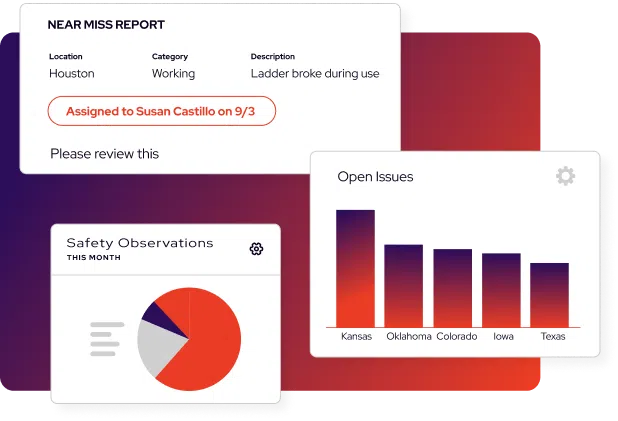
For committees that report up to leadership, Flex makes it easy to show progress in terms leadership actually understands: incident trends, TRIR, training completion rates, and open vs. closed corrective actions. The data is there. You don’t have to build the report from scratch every quarter.
If your committee has been working harder than it should have to, that’s usually a system problem — not a people problem. Flex is built to fix that.