The Hidden ROI of Safety Done Right: How Monterey Mechanical Turned a Culture Shift Into a Business Advantage

Some companies talk about safety as a priority. Others make it a practice so deeply embedded in daily operations that it becomes a competitive edge. Monterey Mechanical Co. belongs to that second category — and the numbers tell the story.
The California-based mechanical contractor works in some of the most demanding environments in the industry: water and wastewater infrastructure, heavy industrial construction, and large-scale mechanical contracting. Crews face confined spaces, elevated platforms, and heavy equipment every day. The stakes for getting safety right are about as high as they come.
Welcome to the Game Changers series, where we spotlight organizations redefining operational safety. Monterey Mechanical – a California-based industrial construction, metal fabrication, and HVAC contractor – was named the Safety Culture Champion at Connect Live 2025, But what made them stand out wasn’t just the outcome of zero recordable injuries. It was how they got there — and what that journey revealed about the true return on investing in operational risk management.
The Conversation Leaders Should Be Having
Most discussions about EHS ROI start and end with incident reduction. Fewer injuries equal lower workers’ compensation claims. Lower claims reduce insurance premiums. That math is real, and it matters.
But the teams doing this work every day know the full picture is more complex. Administrative overhead. Audit preparation. Crew turnover. Project delays caused by compliance gaps. These costs don’t appear on a single line item, but they accumulate — and they’re often far more significant than the direct cost of an incident.
Monterey Mechanical’s path to zero recordables surfaced every one of these categories. Their experience shows what EHS leaders already suspect: a well-executed safety program doesn’t just reduce harm. It eliminates friction across the entire operation.
The Full Cost of Operational Safety Risk
Most organizations measure only direct incident costs. Forward-thinking safety leaders account for all four dimensions — and build programs that address each one.
The most visible costs — the ones that appear directly on your balance sheet after an incident occurs.
The administrative tax on your safety program — hours spent managing processes instead of preventing incidents.
The revenue and productivity impact of work that stops — investigations, idle crews, and delayed project delivery.
The workforce impact of a safety culture that either retains skilled workers — or drives them to competitors.
Direct Costs: The Incident Trend That Changed the Conversation
The data from Monterey Mechanical spans several years of growth — real growth, the kind that puts safety programs under pressure.
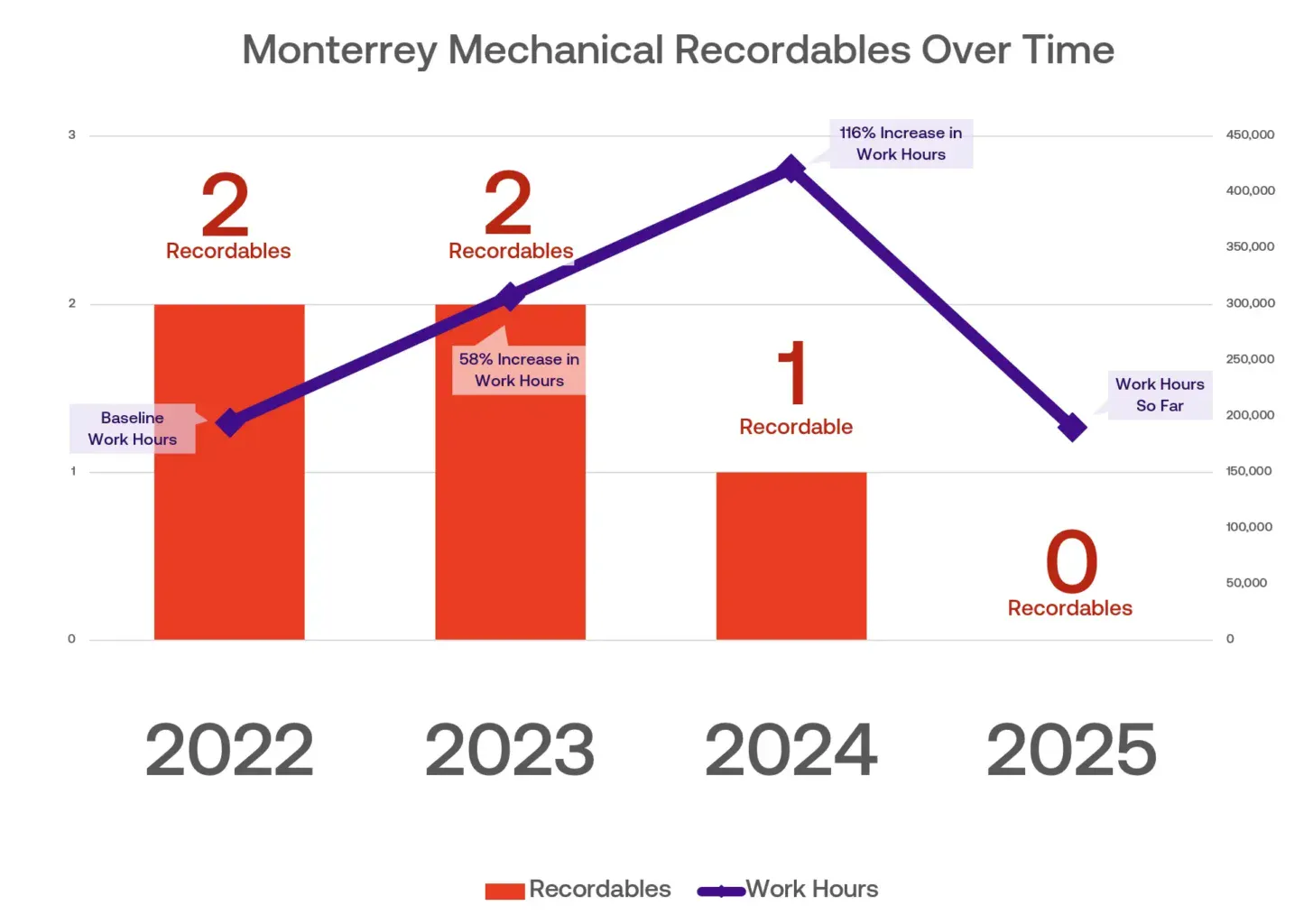
In 2022, they recorded two injuries across their baseline of work hours. In 2023, hours increased 58%, and they still recorded just two injuries. In 2024, hours climbed another 37%, while recordables dropped to one.
That trajectory doesn’t happen by accident. It reflects a deliberate program — and a platform that gave their EHS team real-time visibility into what was happening in the field before incidents occurred.
For any company operating at this scale, the financial impact of sustained incident reduction is significant. Workers’ compensation claims declined. Insurance premiums adjusted accordingly. Litigation exposure — always a looming concern in high-risk industries — decreased. These outcomes are direct, measurable, and substantial. They’re also the results that most easily translate into a conversation with leadership.
What the Safety Culture Champion Award recognized, though, wasn’t just the injury numbers. It was the system behind them.
Indirect Costs: Time Is the Hidden Variable
Before Monterey Mechanical moved to Novara’s platform, their EHS processes looked like those at many contractors: forms scattered across departments, records difficult to locate during audits, training documentation managed through a mix of spreadsheets and paper. Every compliance requirement represented hours of administrative work.
The shift to a centralized, mobile-first platform changed that equation directly.
Pretask plans, hot work permits, inspection records, and training documentation now feed automatically into workflows and reports. Compliance records link directly to people, equipment, and project sites. When an audit arrives, the documentation is already organized. When a supervisor needs to verify that a crew member is certified for a specific task, that information is accessible in the field — not waiting back at the office.
The result: administrative burden dropped 60%, and compliance audits accelerated significantly. For an EHS Director managing operations across multiple active projects simultaneously, that’s not a minor convenience. It’s hours recovered every week — time redirected toward proactive hazard identification rather than paperwork management.
There’s no professional services fee attached to configuration changes, either. When Monterey Mechanical’s needs evolved — when a new project type required new forms, or when workflows needed adjusting — they made those changes themselves. That flexibility eliminates a persistent hidden cost that organizations often absorb without fully accounting for it.
Opportunity Costs: The Projects That Stayed on Schedule
In construction and mechanical contracting, downtime is expensive. A safety incident doesn’t just create human cost — it stops work. It triggers investigations, documentation requirements, potentially regulatory notifications. Depending on severity, it can idle a crew for days.
The flip side of incident reduction is that Monterey Mechanical’s crews stayed on-site and on-schedule. Projects moved forward. Clients saw consistent execution. That operational reliability is a competitive advantage in a market where contractors are evaluated on both capability and track record.
Near-miss reporting played a specific role here. When workers feel empowered to document hazards and unsafe conditions in real time — without fear of reprisal, and with confidence that reports will be acted on quickly — risk gets addressed before it becomes an incident. Monterey Mechanical built that reporting culture into their daily operations. Workers now flag concerns on mobile devices from wherever they’re working. Supervisors receive immediate notifications. Issues close faster. Work continues.
That loop — report, notify, resolve, close — is the operational definition of proactive safety management. It’s also what keeps projects on schedule.
Talent: The Cost Nobody Talks About Enough
Skilled workers in high-risk trades are in demand. Experienced mechanical contractors, certified for confined space entry and elevated work, don’t grow on trees. The cost of turnover in these roles — recruiting, onboarding, training, and the productivity gap during ramp-up — is substantial. Most estimates put the total replacement cost for a skilled trade worker at well above a year’s salary when all factors are included.
Monterey Mechanical’s EHS program functions as a retention tool, even if it isn’t framed that way. Workers who see that safety is genuinely prioritized — not just posted on a breakroom wall but practiced, measured, and continuously improved — make different decisions about where they want to work. The company’s recognition culture reinforces this: safety luncheons, celebratory events, and tangible acknowledgments of the workforce’s commitment to a shared culture are built into how the program operates.
The platform supports this dynamic in a practical way. When workers find the tools they use every day intuitive and useful — when a mobile safety form takes two minutes instead of twenty, when they can access safety data sheets from a jobsite rather than hunting for a binder — adoption follows naturally. Monterey Mechanical’s crews prefer the platform to the paper processes it replaced. That preference is meaningful. It reflects a workforce that sees technology as working for them.
Putting the Full Picture Together
Monterey Mechanical’s selection as the Safety Culture Champion at Connect Live reflects an important truth about how EHS excellence actually works: the organizations doing this best aren’t optimizing for any single metric. They’re building systems where every dimension of the program reinforces every other.
Incident reduction lowers direct costs. Streamlined administration recovers time. Proactive reporting prevents downtime. A culture of genuine care retains the workforce that makes it all run. Each element creates value on its own. Together, they compound.
For EHS leaders who’ve been making the case to finance teams and operations executives that safety investment isn’t a cost center, Monterey Mechanical’s trajectory is a useful reference point. The question isn’t whether this kind of program pays for itself. Based on the evidence, the question is how long you want to wait before finding out.