The Clean Water Act requires a Spill Prevention, Control, and Countermeasure (SPCC) program for organizations that work with large amounts of oil. Having written over 3,000 SPCC programs, we’re here to give you the low down.
What is the SPCC rule?
The SPCC rule is part of the Clean Water Act. It was originally written in 1973 and while it has changed over the years, today it serves to provide regulations for “prevention of, preparedness for, and response to oil discharges at specific facilities.” It outlines the who, what, when, where, and how of SPCC plans such as who needs and plan and what should that plan cover. Let’s get started.
Who needs an SPCC plan?
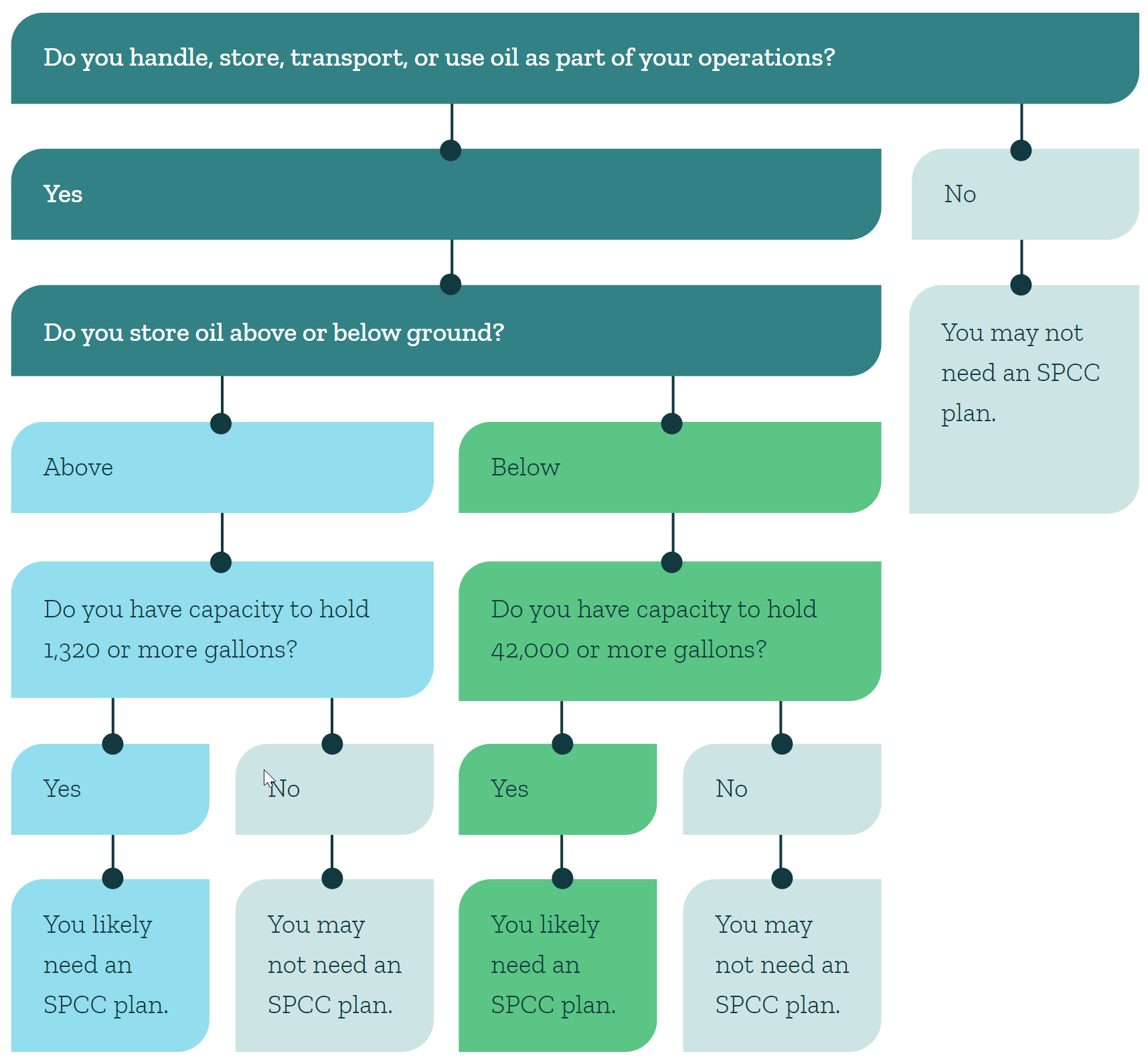
According to the Environmental Protection Agency (EPA), “A facility is covered by the SPCC rule if it has an aggregate aboveground oil storage capacity greater than 1,320 U.S. gallons or a completely buried storage capacity greater than 42,000 U.S. gallons and there is a reasonable expectation of an oil discharge into or upon navigable waters of the U.S. or adjoining shorelines.”
Here’s another way to think about it:
What types of oil does an SPCC plan cover?
Oil as far as this regulation is concerned covers all types of oil such as:
- Petroleum (new and used Oil, ATF, parts cleaning solvent, etc.)
- Gasoline
- Oil refuse
- Greases
- Animal fats and oils
- Vegetable fats and oils
What types of facilities/activities does an SPCC plan cover?
A facility that stores, processes, refines, uses or consumes oil and is non-transportation-related is potentially subject to the SPCC rule. Operations that are intended to move oil from one location to another, i.e. transportation-related, are not included. Here are some examples of covered facilities and operations:
- Onshore and offshore oil well drilling facilities
- Onshore and offshore oil production facilities (including separators and storage facilities)
- Oil refining or storage facilities
- Industrial, commercial, agricultural, or public facilities using or storing oil
- Certain waste treatment facilities
- Loading racks, transfer hoses, loading arms, and other equipment
- Vehicles (e.g. tank trucks) and railroad cars used to transport oil exclusively within the confines of a facility
- Pipeline systems used to transport oil exclusively within the confines of a facility.
What types of facilities or activities aren’t covered by the SPCC rule?
Here are some examples of transportation-related activities or equipment typically not covered by the SPCC rule:
- Interstate or inter-facility oil pipeline systems
- Oil transported in vessels (e.g. ships, barges)
- Oil transported between facilities by rail car or tanker truck
These are covered by other regulations.
Topics your SPCC plan may want to cover include:
- Using appropriate storage and transportation containers
- Process for implementing alarms (or similar devices) to prevent overfilling these containers
- Inspection plan for container, pipes, and other objects used to prevent oil spills
- Replacement plan for worn, weakened, or broken containers, pipes, and other objects used to prevent oil spills.
When you need SPCC Plans, Novara can help.
Novara can prepare plans that meet 40 CFR 112 regulations and are cost-effective for your business, identifying those sites that require SPCC plans and which sites do not require a plan. The goal of these plans is to address what an organization is doing to prevent oil spills and outline how they are preparing in case of a spill.
Plans are generally valid for a period of five years before a review and renewal are necessary, and clients using our EHS software can track their renewal dates online.
KPA’s Facility Compliance Inspections and Loss Control Audit Services assist clients with fulfilling ongoing compliance with the SPCCP Rule.
Novara has written over 3,000 of these programs, and we can help you with yours.