“What’s the ROI on this safety software?”
If you’re an EHS manager, you’ve probably faced this question from your CFO or executive team. You know in your gut that moving from clipboards to cloud-based safety management is the right move, but articulating the financial value can feel like speaking a foreign language.
Recently, we asked our customers in Novara Connect—our customer community—what finally convinced their executives to invest in digital safety. Their answers revealed a pattern: success comes from speaking the language of business value, not safety compliance. Throughout this article, you’ll see their real-world insights on what arguments actually work in the boardroom.
After helping 15,000+ organizations make this transition, we’ve learned exactly how to frame the conversation for maximum impact.
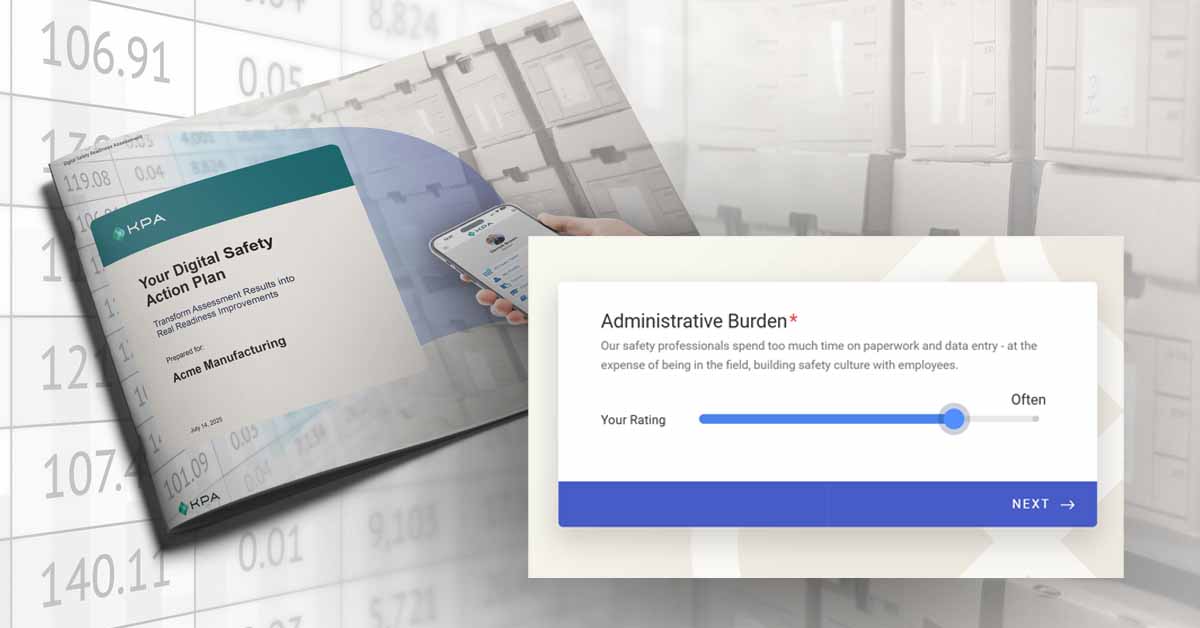
Digital Safety Readiness Assessment
Take Novara’s free 5-minute assessment to see if you’re ready for digital safety management. Get your readiness score & personalized action plan.
Understanding the Executive Mindset
Your leadership team doesn’t evaluate safety investments the same way you do. While you see injury prevention and regulatory compliance, they see risk mitigation and competitive advantage. This disconnect is why so many digital safety initiatives stall in the budget approval phase.
As Nick Hardesty, Novara’s Director of EHS Field Services, explains: “If you can align your goals with the company in general, you’re going to be in a much better position to get that funding.”
Stop leading with compliance arguments. Instead, position digital safety as a strategic business move that:
- Reduces operational costs
- Improves efficiency
- Enhances competitive positioning
- Drives measurable ROI
Stephanie Mei, Process & Compliance Manager at BGDC Distribution, kept it simple: “ROI data” was all she needed to convince her leadership.
Building Your ROI Framework
Quantifying Current Costs
Before you can demonstrate savings, you need to understand your true costs. Most organizations dramatically underestimate the cost of manual safety processes.
As Bill Woods, Director of Safety, Quality and Regulatory Compliance at American Welding & Gas, discovered:
“Being able to show historical data based on current systems and then projecting data with new systems in place” was crucial. Once implemented, he emphasized the need to “measure various KPI to show how investment has impacted the performance.”
The True Cost of Incidents: It’s not just workers’ compensation. According to OSHA, indirect costs are usually uninsured and can vary inversely with injury severity—the less serious the injury, the higher the ratio of indirect costs to direct costs. These include:
- Lost productivity and overtime coverage
- Training replacement workers
- Investigation time and documentation
- Potential OSHA fines and legal fees
- Increased insurance premiums
- Reputational damage
Administrative Time Drain: Manual processes create massive inefficiencies. Think about safety managers spending their days doing inspections with pen and paper on a clipboard, going back to the office, typing up minutes and inspections. When safety professionals are trapped in paperwork, they can’t be in the field building culture and preventing incidents.
Data collection and analysis are something that is very lacking without a system to track.”
– Matthew Bailey, EHS Manager at Alleguard | Watch the Alleguard interview
There was nothing in place to track data. We have people in the field at job sites, and the instant responses were a huge selling tool!
– Judy DeForeest, EHS & Quality Coordinator, LDX Solutions
Compliance Exposure: Manual tracking of training certifications, inspection schedules, and regulatory requirements leaves dangerous gaps. For 2025, OSHA’s maximum penalties have increased to $16,550 per violation for serious and other-than-serious violations, and up to $165,514 per violation for willful or repeated violations.
Projecting Digital Benefits
Now translate those costs into quantifiable savings through digital transformation:
Time Savings = Cost Savings: With digital safety management, organizations report significant time savings on administrative tasks. By reducing manual paperwork and automating workflows, safety managers can redirect their efforts to proactive safety culture building and field engagement.
It was a combination of ROI and ease of use for our employees. We could save time, money, and give a scenario where the employees would not spend as much time away from home and family.”
– Timothy Shaw, Information Success Coordinator, McCumber Well Service
One corporate field safety coordinator noted simply: “ROI just based on time savings” was enough to convince leadership.
Incident Reduction Through Proactive Management: According to research from the National Safety Council, organizations that implement comprehensive safety programs can see substantial reductions in injury rates. OSHA reports that effective injury and illness prevention programs could reduce injuries by 15-35% for employers who don’t currently have safety programs.
The biggest pitch was better data tracking and going paperless, as well as an easy-to-use program.
– Rene Tinoco, HSE Administrator, SER Construction
Compliance Confidence: Automated tracking and alerts virtually eliminate compliance gaps. Everything can now be centralized in one place. It’s always accessible and easy to update.
Five Winning Arguments for Digital Safety
Overcoming Common Objections
The Novara Advantage in Executive Conversations
When presenting to leadership, leverage Novara’s proven track record:
- 15,000+ successful implementations across every industry
- Configurable platform that adapts to your processes, not the other way around
- Expert consulting team with over 120 specialists averaging 20+ years experience
- Comprehensive support ensuring adoption and ongoing success
- Industry-specific expertise with relevant benchmarks and best practices
We wanted to keep improving our safety culture on the jobsite. Senior leadership is bought in, and when we wanted to use new innovative ways of doing things, it was a pretty easy sell.
– Senior Safety Specialist, Construction
The Strategic Imperative
Digital safety transformation isn’t a nice-to-have—it’s a strategic imperative. Organizations clinging to manual processes face escalating costs, increasing risks, and competitive disadvantage.
The question isn’t whether to digitize your safety program, but how quickly you can make it happen. Every day of delay means:
- More time wasted on manual processes
- Greater exposure to preventable incidents
- Lost opportunities to build safety culture
- Competitors pulling further ahead
The path forward is clear. The business case is compelling. Now it’s time to act.
Build Your Business Case with Confidence

Or let Novara’s experts help you build a customized business case. Schedule an executive briefing to get started.
Related Content
Explore more comprehensive articles, specialized guides, and insightful interviews selected, offering fresh insights, data-driven analysis, and expert perspectives.