Every safety professional has faced this tension during a growth period: work hours are climbing, headcount is expanding, job sites are multiplying — and the safety program that worked last year is straining to keep up.
For most organizations operating in high-risk environments, the honest answer is complicated. Growth means new hires who haven’t absorbed the culture yet. It means more job sites with less direct oversight. It means the processes that worked for a 50-person crew start to buckle under the weight of 150. And in construction, metal fabrication, and heavy industrial work — where a breakdown in process isn’t abstract — “figuring it out as we go” isn’t a strategy anyone should be comfortable with.
Welcome to the Game Changers series, where we spotlight organizations redefining operational safety. Monterey Mechanical – a California-based industrial construction, metal fabrication, and HVAC contractor – was named the Safety Culture Champion at Connect Live 2025, after more than doubling their work hours while driving injuries to zero. Their playbook is one every safety leader managing growth should see.
Monterey Mechanical didn’t just face that question. They answered it with data, discipline, and a deliberate approach to building safety culture that scales.
The Scaling Problem Nobody Wants to Talk About
Here’s the uncomfortable truth about safety programs in high-growth companies: most are designed for the organization’s current size, not its future one. And when growth outpaces the program, something gets sacrificed — usually visibility, consistency, or both.
When you’re running a tight crew across a handful of job sites, a strong safety director, well-trained supervisors, and solid paper-based systems can get the job done. Visibility is high. Communication is direct. Culture is reinforced through daily, face-to-face interaction.
But growth changes the math. A 58% jump in work hours — the kind Monterey Mechanical experienced between 2022 and 2023 — doesn’t just mean 58% more exposure. It means new workers learning the ropes, new sites that leadership can’t physically visit every day, and new complexity in tracking inspections, training records, pre-task planning, and incident trends across the entire operation.
What Monterey Mechanical Did Differently
Rather than treating safety as something that would naturally scale through good intentions, Monterey Mechanical’s leadership made a strategic decision: they invested in the infrastructure to scale safety systematically.
The foundation of their approach rests on a philosophy they call “Beyond Zero.” The name matters. Zero recordable injuries is a goal most safety programs aspire to. Beyond Zero reframes that target as a starting point — a floor, not a ceiling. It’s about building an environment where workers don’t just avoid incidents but actively participate in identifying and eliminating risks before anyone gets hurt.
That’s a cultural mindset. But culture alone doesn’t scale across multiple job sites, shifting crews, and thousands of additional work hours without sacrificing consistency. It needs a system that keeps everyone connected to the same standards, no matter where they’re working.
Monterey Mechanical turned to Novara’s mobile platform to serve as the connective tissue between their safety culture and their daily operations. The decision wasn’t about adopting new technology for its own sake — it was about choosing a configurable system they could shape to match how their crews actually work in the field, rather than forcing everyone into a rigid, one-size-fits-all process.
It’s one of the reasons the team earned the Safety Culture Champion award — their approach shows what happens when the right culture meets the right tools.
Game Changers: Scaling Safety Excellence - Monterey Mechanical's Blueprint for Sustainable Safety Culture
Join us as Monterey Mechanical, winner of KPA's 2024 Safety Culture Champion award, shares how they scaled safety excellence by increasing work hours by 116%.
The Numbers Tell the Story
Data removes ambiguity. And Monterey Mechanical’s numbers are unambiguous.
In 2022, the company recorded 2 injuries across almost 200,000 work hours — a strong baseline by industry standards. Then growth kicked in. In 2023, hours worked jumped 58%, and they still recorded just 2 injuries. Their incident rate actually dropped. In 2024, hours climbed another 37% — a cumulative 116% increase from the 2022 baseline — and recordable injuries fell to 1.
By 2025 they reached zero recordables.
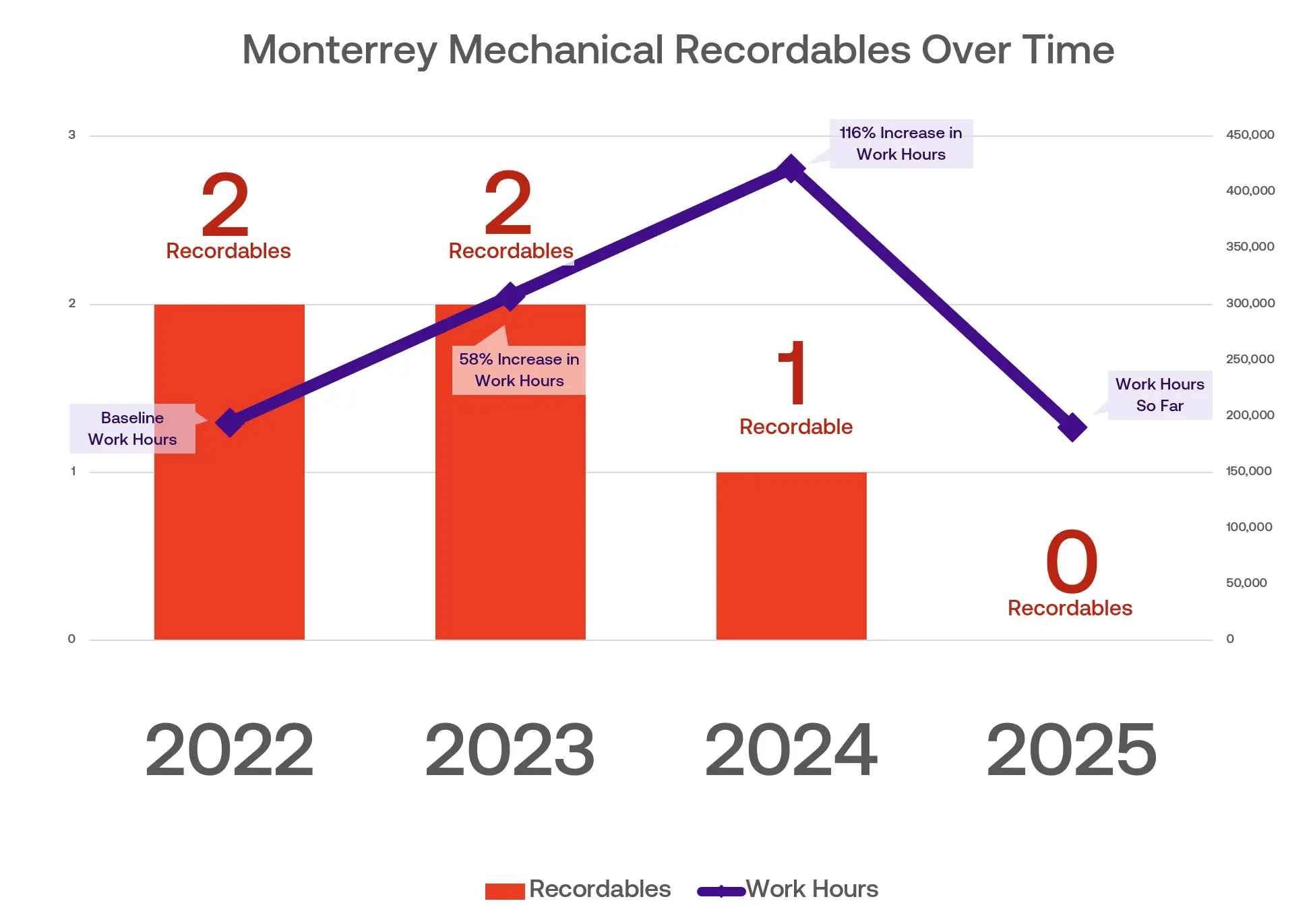
That trajectory — work hours more than doubled, injuries meaningfully reduced — isn’t luck. It’s the result of a system where every new worker gets onboarded into the same culture and trained on the same expectations, regardless of which job site they’re assigned to. It’s what happens when you digitize pre-task planning and inspections so nothing falls through the cracks when supervisors are stretched across more projects. And it’s what comes from giving leadership real-time visibility into the entire operation — not last week’s paper reports sitting in a binder somewhere.
How a Mobile Platform Changes the Equation
The specific mechanics of how Monterey Mechanical made this work are worth examining — not just because the results are impressive, but because they form a replicable playbook for any organization managing growth across multiple sites.
The Cultural Multiplier
Technology enables scale. But Monterey Mechanical’s results — the results that earned them the Safety Culture Champion recognition at Connect Live — also reflect something you can’t configure in a dashboard: genuine investment in people.
The company hosts Safety Luncheons, recognition events, and appreciation programs that reinforce safety as a shared value rather than a top-down mandate. They distribute branded gear and organize team outings. They’ve built an environment where every worker feels confident stopping unsafe work without fear of reprisal.
This matters because the most sophisticated platform in the world fails if people don’t use it. Monterey Mechanical’s approach works because the technology serves the culture, not the other way around. Field workers prefer the mobile tools over paper because they’re intuitive and put everything in one place. When adoption is high, the data gets richer, the insights get sharper, and the safety program gets stronger — a cycle that compounds over time.
That’s the real lesson from Monterey Mechanical’s story: scalable safety isn’t a technology problem or a culture problem. It’s both, working together.
What This Means for Your Organization
Monterey Mechanical’s trajectory isn’t about a company that got lucky during a growth period. It’s a deliberate playbook: pair a strong safety culture with a configurable platform, and you build a program that scales without sacrificing the things that matter most — visibility, consistency, and the trust of the people doing the work.
If your organization is growing, adding sites, or managing more work hours than you were two years ago, the question isn’t whether your safety program needs to evolve. It’s whether it’s keeping up.
The contractors and safety leaders who figure this out early — who invest in scalable systems and genuine cultural commitment before the growth curve forces their hand — are the ones who end up with track records like Monterey Mechanical’s. And those track records do more than reduce injuries. They win contracts, reduce insurance costs, improve retention, and build reputations that attract the best talent in a tight labor market.
Related Content
Explore more comprehensive articles, specialized guides, and insightful interviews selected, offering fresh insights, data-driven analysis, and expert perspectives.