
Only 6% of organizations have achieved a fully digital safety management system.
That’s not a typo. It’s one of the headline findings from The Simplicity Imperative, a new research report from Novara based on a cross-industry survey of safety and EHS professionals conducted in October 2025 in partnership with EHS Leaders. Nearly 200 respondents—spanning manufacturing, construction, energy, oil and gas, utilities, and other hazardous industries—shared how they actually manage safety day to day. The data paints a stark picture of where the industry stands versus where it needs to be.
After years of available technology, real investment, and no shortage of vendor promises, three-quarters of organizations haven’t achieved the digital transformation safety software has promised. Most teams are still managing with some combination of paper binders, spreadsheets, and disconnected digital tools.
If you’re a Safety Director or EHS Manager running your program through a patchwork of manual processes and half-adopted platforms, you already know this. You live it every day.
Where Organizations Actually Stand
The data breaks down like this: 7% of organizations are still primarily paper-based. Another 27% are mostly paper with basic digital tools like spreadsheets and simple forms. The largest group—41%—describes their approach as roughly equal between digital platforms and manual processes. Only 19% are mostly digital, and just 6% have reached full digital integration.
Add those first three groups together and you get the 75% figure: three out of four safety operations are straddling the paper-digital divide.
This isn’t an indictment of individual safety teams. It’s an industry-wide reality. These are professionals doing critical work with scattered processes when they need one system, one source of truth. The gap between what they’re working with and what they actually need is enormous.
The Simplicity Imperative
This original research report breaks down the full findings from safety professionals across six industries—including the cost of complexity, the evaluation criteria that matter, and role-specific recommendations for Safety Directors, Operations Leaders, and Executives.
This Isn’t a Technology Problem
Safety software has been available across every price point and feature set for years. The issue isn’t availability—it’s adoption.
Think about it from the Safety Director’s chair. You’ve probably evaluated platforms that look impressive in a demo but require IT support to configure. You’ve sat through training sessions that half your team skipped. You’ve watched frontline workers open an app once, get frustrated by the interface, and go back to clipboards and paper forms.
The research confirms this: 35% of safety leaders say frontline engagement and employee buy-in is the single biggest challenge impacting their safety program. Not budget. Not compliance. Not data. The people who need to use the tools aren’t using them.
And who can blame them? When a system takes longer to fill out than a paper form, when it requires a Wi-Fi connection on a remote job site, when it demands training that nobody has time for—workers find workarounds. They always do.
What Complexity Really Costs
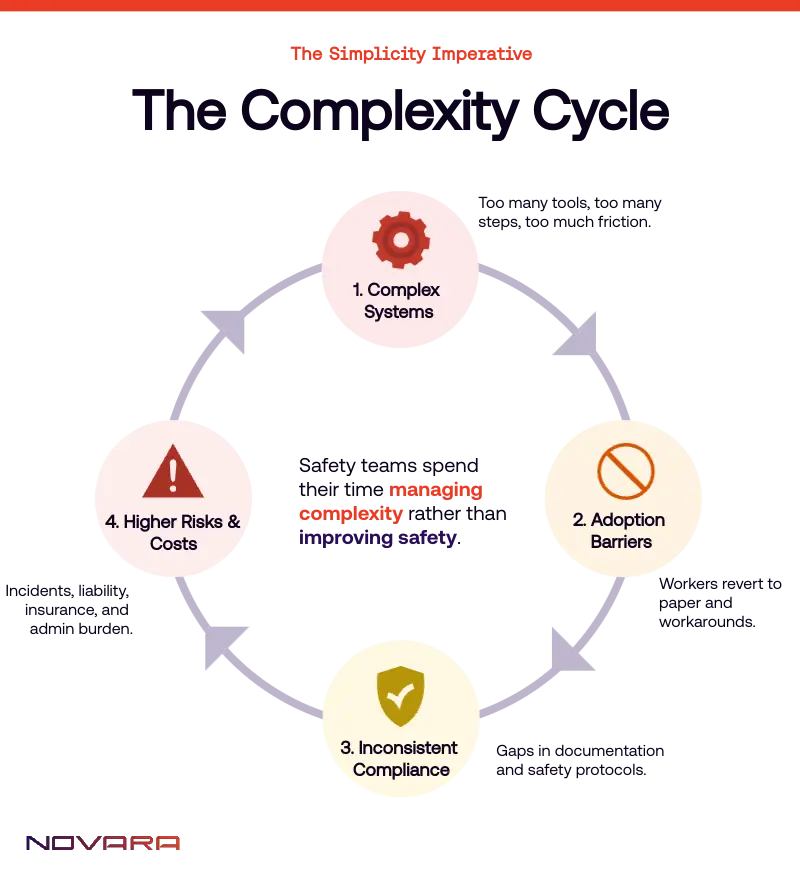
Complexity doesn’t just slow adoption. It creates a cycle that compounds over time.
Complex systems create adoption barriers. Low adoption leads to inconsistent compliance. Inconsistent compliance increases incident risk. Higher risk drives up insurance, liability, and operational costs. And the whole time, safety managers spend more hours documenting safety than actually improving it.
That’s the real cost of the 75% problem. It’s not just operational inefficiency—it’s compliance exposure, it’s incident risk, and it’s safety teams buried under administrative burden instead of doing the proactive work that prevents injuries.
The data backs this up: 11% of respondents cite time-consuming manual data entry as their primary challenge. Another 10% can’t demonstrate ROI to leadership—which means they struggle to justify the investments needed to break free from the cycle.
What the Data Says Works
Here’s where the research gets interesting. When asked what matters most when evaluating safety management platforms, safety leaders gave a clear answer: 55% rank ease of use and user adoption as their #1 evaluation factor. That beats cost (43%), customization (38%), comprehensive features (37%), and integration capabilities (28%).
This is a fundamental shift. After years of purchasing feature-rich platforms that workers avoided, the industry has learned a hard lesson: complexity is the enemy of adoption, and adoption is everything.
And when asked what measurable improvement would make the biggest impact, 64% said increased employee engagement—more than proactive hazard identification (51%), reduced admin time (40%), or better compliance scores (30%). Safety leaders understand that if their people don’t use the system, nothing else matters.
Simplicity isn’t about doing less. It’s about removing the barriers between good intentions and daily execution. It’s about technology that works the way people work—not the other way around.
How Novara Flex Bridges the Gap
Novara Flex was built to address exactly what this research identifies. The platform was designed from the ground up around one question: will frontline workers actually use this?
For the 55% who prioritize ease of use, Flex delivers intuitive workflows that require no training. For the 35% struggling with frontline engagement, a mobile-first design puts your entire safety program in every worker’s pocket—with offline functionality, QR code access, and push notifications that remove every barrier to adoption.
For safety managers drowning in manual processes, automated reminders replace spreadsheet tracking. Centralized documentation means audit prep takes minutes, not days. And for organizations managing a patchwork of disconnected point solutions, Flex consolidates training, inspections, incidents, SDS, and compliance into one platform.
Implementation anxiety? Flex customers go from contract to full operation in weeks—with pre-configured industry templates and dedicated support. No 6-month rollouts. No heavy IT lift. No compliance gaps during transition.
Simplicity isn’t about doing less. It’s about removing the barriers between good intentions and daily execution.
The Full Picture
The 75% problem is real—but it doesn’t have to be permanent. The same research that reveals the gap also maps the path forward: what safety leaders actually want from technology, why adoption matters more than features, and what it takes to bridge the divide.
Related Content
Explore more comprehensive articles, specialized guides, and insightful interviews selected, offering fresh insights, data-driven analysis, and expert perspectives.