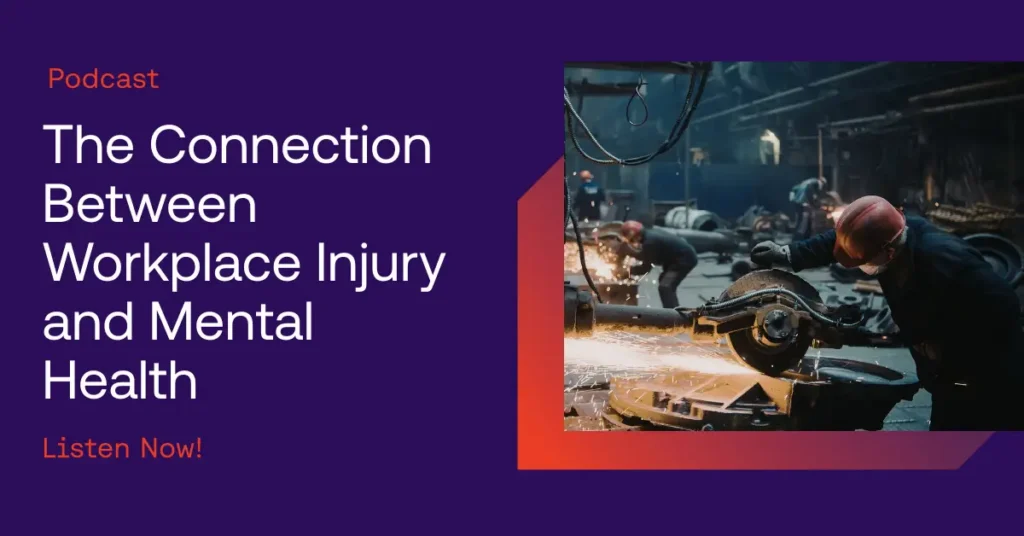
Get ready to step into the Safety Meetings Safety Lab, where we break down the latest research and studies in workforce safety. Join us as we dive deep into the data and uncover fresh insights to make your workplace safer, smarter, and more informed.
In this episode of The Safety Meeting’s Safety Lab, we delve into the relationship between physical injuries at work and mental health. Highlighting a comprehensive meta-analysis by Granger and Turner involving data from 147 studies with 1.5 million people, we discuss the bidirectional connection between workplace injuries and mental health challenges. We explore the impact of injury severity and frequency on mental health, and unpack the importance of integrating both psychological support and physical rehabilitation, for an employee returning to work.
Today, we’re digging into the hidden connection between physical injuries at work and mental health. Organizations sometimes act like physical safety and mental wellness are totally separate things, but the research we’re looking at today shows they’re basically two sides of the same coin. We’re unpacking a major meta-analysis by Granger and Turner. They pulled together data from 147 studies with almost 1.5 million people involved. It gives some serious weight to the findings.
It really does. It lets us say with confidence what the real relationship between physical and mental health looks like. And the big headline finding right off the bat is that there’s a clear, consistent link between getting injured on the job and then facing mental health issues later on. The research really confirms that this is a two-way street, a bidirectional relationship. Getting physically injured can absolutely result in mental health struggles. That part makes sense, right? But it also works the other way. Existing mental health challenges, like anxiety, depression, even high stress, can actually make someone more likely to get physically injured in the first place as well.
Yeah, kind of like it feeds itself. And for a safety manager, someone thinking about budgets, about prevention, why is understanding this two-way street so crucial? What’s the real cost if you keep treating these as separate issues?
The costs are enormous, and they spread way beyond that initial worker’s comp claim. We’re talking significant lost productivity, obviously, that’s like people off work, or maybe worse, people at work but not really functioning. Then there are the budget hits for recruitment, for training replacements when people can’t or don’t come back effectively. And maybe the biggest hidden cost is the long-term healthcare expenses. So chronic physical issues often go hand-in-hand with chronic mental health issues, and that can get very expensive over time.
I mean, it sounds like a massive drain organizationally. And something you mentioned there about people not coming back effectively ties into another problem. I know the research highlights underreporting, which makes the whole thing even harder to manage.
Yeah, exactly. That’s a huge piece of the puzzle. The study points out that the numbers we see for injuries and for mental health struggles, they’re way lower than reality because people are often afraid to report. They worry about, you know, getting sidelined or losing chances for promotion, or maybe they just feel like their workplace won’t actually support them if they admit they’re struggling mentally or, like, need particular accommodations during their recovery.
So, you could be looking at your safety dashboard, seeing fairly low incident rates and thinking, ‘Great, we’re doing well.’ But underneath the surface, you could have a workforce dealing with unreported injuries and significant psychological distress, all because the system might implicitly punish honesty. You’re flying blind to actual levels of risk, which means you’re likely underestimating the true cost and potential for bigger problems down the road.
Yeah, yeah, precisely. If people aren’t reporting, you can’t step in early. And so the hidden costs just keep mounting, and of course, so does the suffering. The official metrics just don’t capture the full picture of this intertwined physical and mental health risk.
Okay, so let’s shift gears a bit. We know the link goes both ways from a practical standpoint. For safety managers deciding where to put resources, especially for rehab, does one direction pack a bigger punch than another?
Yeah, it does. And the evidence here is pretty clear. While both pathways exist, the connection is significantly stronger when a work injury comes first that leads to subsequent mental health challenges. So when they looked at this thing, the effect of injury causing distress later on was much more significant than the opposite: mental health issues leading to injury.
Hmm. That’s interesting because you might think someone struggling with depression might be less focused, more prone to accidents. Why is the injury-to-distress path a more prevalent one?
Well, it really relates to a concept called uncertainty and illness theory. So think about a typical acute work injury, like a fall or getting caught in machinery or, say, a sudden back injury from lifting something awkwardly. These events are usually abrupt. They’re unexpected. And they really disrupt a person’s life and their sense of predictability.
Okay, so it’s the suddenness. The shock of the physical event that creates this intense immediate uncertainty about everything else.
Exactly. The uncertainty isn’t just about ‘Will my arm heal?’; it expands into bigger questions: ‘Can I still do my job? Can I still provide for my family? What are my physical limits going to be? Will I even have a job?’ And so this sudden catastrophic wave of doubt is, psychologically speaking, much more acute than, say, the slower, more gradual onset of something like low-grade depression might be on its own.
Can you paint a picture of how that uncertainty actually turns into clinical anxiety and depression?
Sure. Yeah, so before the injury, maybe the worker felt reasonably safe, felt they had some control over their work life. Psychologists sometimes call this a ‘positive illusion.’ And the injury just shatters that illusion instantly. And what happens then, and this is according to Granger’s work, is that the worker starts to ruminate, and they get stuck in these negative thought loops: ‘What if I hadn’t taken this shift? What if I had refused to do that task? How will I pay my mortgage if I’m permanently limited? Will I ever feel healthy again?’ And so that constant churning, fueled by deep uncertainty about their physical, financial, job future, this can lead directly to serious anxiety, depression, and even PTSD.
Wow. So the physical injury acts almost like a catalyst, igniting this fire of uncertainty, and the mental health problems are a result of that person’s struggle to cope with that sudden loss of control and predictability. So if the injury is the catalyst and the uncertainty is the fuel, we need to understand how that fire spreads. What are the actual mechanisms connecting the physical event to the psychological outcome? Because those are the points where managers can potentially step in, right?
Yeah, exactly. The mechanisms are crucial because we can actually influence mental health outcomes with the right interventions. So when injury leads to distress, it can result in negative cognition. These are negative thoughts, basically. Specifically things like mentioned, rumination, going over and over the event and its consequences. This is a kind of catastrophizing, which assumes the absolute worst possible outcome. These are feelings of helplessness and even self-blame. And so the analysis shows a really substantial link here: the injury significantly predicts mental health problems through this amplification of negative thinking patterns.
Mm. It’s the way the person thinks about the injury and its implication that really drives that decline in mental health.
Yeah, exactly. So the injury may, I don’t know, say break their arm, but the negative cognitions break their sense of hope, their belief in recovery, their feeling of control. And so helping manage that cognitive response is pivotal to preventing a deeper slide. And so for safety managers, this means that psychological support shouldn’t wait for a formal diagnosis months down the line; it needs to happen quickly to interrupt those initial negative thought patterns. And so consider an early intervention focused on cognitive reframing to manage this initial wave of distress and catastrophic thinking.
Yeah, that makes sense.
But then what about the other direction? When a worker’s mental health challenges lead to an injury?
Well, the key mechanism there is the concept of perceived job demands. It’s like, if I’m already stressed or depressed, my job feels even harder. It’s like a resource issue. Mental health problems like chronic stress, anxiety, or depression, they take up a lot of your cognitive bandwidth. Your attention, your ability to focus, your vigilance, your processing speed, they’re all taxed before you even start your workday. So you’re basically starting the day with potentially drained battery, mentally speaking.
Oh yeah, that makes sense. So you’re like operating with a cognitive deficit. And when that happens, the normal everyday demands of your job tasks, which you could usually handle just fine, start to feel overwhelming. Ah, they’re perceived as having much higher demands than they actually do objectively.
And that feeling of being overwhelmed, of not having the mental resources to cope, that’s when mistakes happen. That feeling of overwhelm increases the likelihood of taking shortcuts, having lapses in attention, reacting slower to hazards. The mental fog associated with poor mental health directly increases vulnerability to making errors that can lead to physical injury. So for a safety manager, investing in mental wellness programs and reducing stressors is not just about being supportive or a good manager; it’s about actively restoring the cognitive resources that people need to work safely and to avoid physical hazards in the first place.
Absolutely. It’s a direct investment in physical safety by addressing and reducing the perceived job stressors.
Okay, so let’s bring it down to brass tacks. We’ve got this huge data set, nearly 1.5 million people. How do we use this knowledge to actually make safety programs and return to work plans better?
Well, let’s start with how we measure injury itself. The study found that not all injuries are equal in terms of their psychological risk. This is a really critical finding for how we allocate resources. The study found that if you’re just tracking whether an injury happened or not, like a simple yes/no checkbox, the link to mental health issues is there, but it’s relatively modest.
It kind of implies all injuries have the same psychological weight, which, given this data, doesn’t feel right.
Yeah, exactly. Once you start measuring injury based on severity, like, “how bad was it?” or start measuring frequency like, “how often has this person been injured?” Then the association with subsequent mental health problems jumps significantly. It becomes much stronger.
Okay, so the worse the injury or the more often someone gets hurt, the higher the risk of serious psychological fallout.
Yeah, because more severe or frequent injuries create much more uncertainty about the future, physical recovery, job prospects, financial stability, and we know that that uncertainty is the key driver. And so the actionable insight here for managers is pretty clear: your level of psychological follow-up and support needs to scale up based on the severity and frequency of injuries. It can’t just be a, say, standard protocol triggered solely by filing a compensation claim. More severe injury needs more intensive psychological support.
Which flows right into my next point: integrated rehabilitation. If those negative thoughts, that uncertainty activates right after a serious injury, waiting months for mental health checks seems, well, too late. It’s likely too late to prevent the significant distress in many cases. The study explicitly calls for this integration. Psychological rehab shouldn’t be an afterthought. It needs to happen alongside the physical rehab, right from the start. You need programs designed to address the uncertainty, help manage those initial negative cognitions, and maybe even discuss how perceived job demands might feel different upon return before the physical healing is even complete. Your aim should be returning a worker who is whole in body and mind.”
And one last additional point about this like measurement and safety record keeping; this may seem technical, but it does have practical implications for how a safety manager might monitor their workforce. So the research pointed out that a common practice is taking something nuanced like a score on a depression scale that ranges from, let’s say 0 to 60, and just collapsing it to two boxes: ‘depressed’ or ‘not depressed’. They call this ‘dichotomizing,’ forcing something on a spectrum into a simple yes/no.
And when researchers did that, the study found it actually weakened the observed link between injury and mental health. The effect size looked smaller. But simplifying the data too much, you actually lose sight of some of the real strength of that connection.
Totally. You especially lose sight of people experiencing subclinical distress. They might not meet the strict criteria for, say, major depression, but they still could be struggling with significant anxiety, rumination, or stress that is in fact draining their cognitive resources. And as we discussed, this makes them more vulnerable to injury. So if managers rely only on these coarse dichotomized measures, these simple yes/no questions, they’re likely undercounting the true extent of psychological suffering in their workforce and missing massive opportunities for early preventative intervention.
That’s fascinating. And frankly, a bit sobering. To summarize, the connection is real; it’s bidirectional, but the path from physical injury to mental distress is particularly strong, largely because of the intense, sudden uncertainty these events create. And that uncertainty fuels negative thinking patterns.
Yeah, and then on the flip side, existing mental health issues drain cognitive resources, making standard job tasks feel overwhelming, and that overwhelm increases injury risk.
And as we said, the solutions point toward integrated rehab—starting psychological support immediately alongside the physical recovery and scaling that support based on the injury severity and frequency.
And as well, safety managers ought to reconsider overly simplistic measurement tools, which might be hiding the true scope of these problems.
Okay, so let’s leave our listeners with a final thought to chew on. We know these common measurement practices like boiling complex stress down to a ‘yes’ or ‘no’ actually underestimates the real strength of that physical-mental health link. It means the true amount of psychological suffering tied to work injuries is likely even greater than what Granger and Turner’s meta-analysis captured. So, as safety managers, I think research like this should be considered when formulating a safety program, ensuring that both physical and psychological health are part of that conversation.
Yeah, thinking about that really shifts the focus from just reacting to injuries and diagnosed conditions toward a much deeper, truly preventative approach to workforce well-being.
Well, that’s all we’ve got for you today. A huge thank you to everyone listening for joining us. Keep those brains engaged and we’ll catch you in the Safety Lab next time. Stay safe out there.
Related Content
Explore more comprehensive articles, specialized guides, and insightful interviews selected, offering fresh insights, data-driven analysis, and expert perspectives.