Do you know everything you need to know about the 10 most frequently cited Occupational Health and Safety Administration standards for construction? In this series, we’re exploring the most common OSHA violations, one by one. Keep reading to learn how to avoid OSHA citations and protect your workforce from fall hazards.
OSHA’s Top of the Tops
When looking at OSHA’s top 10 most cited standards in construction, the clear winner for most violations goes to fall hazards on roofs, scaffolds, lifts, and ladders. And not surprisingly, for the 10th year in a row fall protection was the most frequently cited OSHA violation. Included on OSHA’s top 10 list of most-cited violations include:
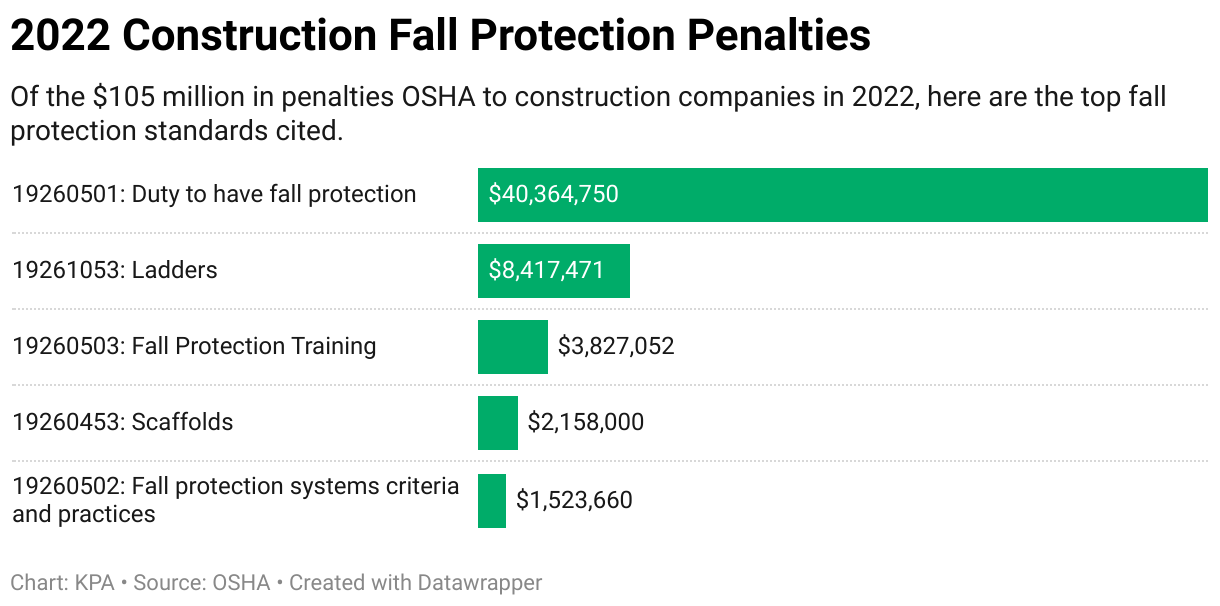
The Bureau of Labor Statistics (BLS) reported that nearly 1 in 5 workplace deaths occurred in the construction industry. Just over one-third of construction deaths were due to falls, slips, and trips. Of these, almost all were from falls to a lower level. The construction industry accounted for 46.2 percent of all fatal falls, slips, and trips in 2021.
OSHA recognizes that fall incidents are typically complex events that can involve a variety of factors. OSHA’s standard for fall protection addresses both human factors as well as equipment-related issues in its effort to protect workers from fall hazards.
OSHA’s Fall Protection Standard: What it is
OSHA definition:
OSHA’s Subpart M addresses the requirements and criteria for fall protection in construction workplaces. It applies when workers are working at heights of 6 feet or more above a lower level. The provisions of Subpart M can be found in Title 29 Code of Federal Regulations (CFR) Subpart M – Fall Protection, 29 CFR 1926.500, 29 CFR 1926.501, 29 CFR 1926.502, and 29 CFR 1926.503. (Source)
Simple definition:
When construction workers are performing work at heights of 6 feet or more they must be protected from falling.
How to protect workers at heights
OSHA defines fall protection as “any equipment, device, or system that prevents a worker from falling from an elevation or mitigates the effect of such a fall.” Employers may choose from the following fall protection options:
- Guardrail System – A barrier erected along an unprotected or exposed side, edge, or other area of a walking-working surface to prevent workers from falling to a lower level.
- Safety Net System – A horizontal or semi-horizontal, cantilever-style barrier that uses a netting system to stop falling workers before they make contact with a lower level or obstruction.
- Personal Fall Arrest System – A system that arrests/stops a fall before the worker contacts a lower level. Consists of a body harness, anchorage, and connector, and may include a lanyard, deceleration device, lifeline, or a suitable combination.
- Travel Restraint System – A combination of an anchorage, anchorage connector, lanyard (or other means of connection), and body support to eliminate the possibility of a worker going over the unprotected edge or side of a walking-working surface.
Why Fall Hazards in Construction Happen
Fall protection violations are very common because construction workers are frequently exposed to fall hazards when working on rooftops, openings on sides of buildings, scaffolding, mobile elevated work platforms (lifts), ladders, and other heights. According to the BLS, of the 5,283 worker deaths in 2023, 885 were the result of a slip, trip, and fall accident.
Some common causes of fall protection violations include:
- Improper ladder use
- Using a defective ladder
- Scaffolding collapse
- Lack of scaffold inspection by a competent person
- Absence of guardrails
- Faulty stairways
Check it out:
Read up on all of the top violations in the OSHA Top 10 Resource Hub
What You Stand to Lose When Fall Hazards in Construction Happen
Direct costs: OSHA penalties can exceed $16,000 per violation—and as much per day for every day the issue hasn’t been fixed by OSHA’s deadline. The fine for a willful or repeated violation can be 10 times as much.
Indirect costs:
- workers’ compensation claims from workers injured from a fall
- lost productivity during and after an incident
- legal and compliance fees
- decreased morale
- negative publicity and reputational damage
Signs You’re at Risk of Fall Protection Violation
Working at heights is extremely common in the construction industry. Anytime a worker is working at 6 feet or more near unprotected openings and edges there is a risk of falling. And the farther the fall, the more dangerous the outcome.
Every worker who works at heights needs to understand the risks of a fall and what measures must be put into place to prevent them from falling. Training should be conducted annually.
How to Avoid a Fall Protection Violation: Your Prevention Checklist
- Are all anchorages capable of supporting a 5,000-pound load per worker attached?
- Has all personal fall arrest equipment been inspected prior to use for wear and damage, including tears, burns, ripped stitching, and buckle or connector damage?
- Do lifelines, lanyards, snap hooks, and D-rings have a minimum strength of 5,000 pounds?
- Has a rescue plan been designed and implemented for the particular fall protection system being used on the project?
- Have employees been trained in rescue equipment and techniques?
- Are guardrails at the proper height? The height of the toprail must be between 39 inches (0.9 meters) and 45 inches (1.2 meters). Each toprail or guardrail system must be capable of withstanding 200 pounds of force.
- Are midrails installed correctly? Midrails must be installed approximately halfway between the toprail and the platform surface. The midrail must support 150 pounds of force.
- Are ladders free of damage and debris?
- Are ladders the appropriate type and height for the job?
- Are extension ladders set at an appropriate angle (4 to 1)?
- Are ladders placed on a firm and flat surface?
- Has the scaffold been designed by a qualified person?
- Are guardrails or personal fall arrest systems being used for fall prevention/protection are required for workers on platforms 10 feet or higher?
- Is the scaffold inspected daily by a competent person prior to each work shift?
- Have employees been trained in accordance with OSHA’s regulation 1926.503?
You Don’t Have to Manage Your OSHA Requirements Alone
Have questions? Looking for more detailed OSHA compliance guidance?
Novara is here to help.
To truly protect your workforce and bottom line, you’ll need in-depth information—and not just about OSHA’s top 10, but every potential hazard that exists in your organization. You’ll also need to conduct a thorough evaluation of your facilities to identify current gaps and risk areas.
KPA’s unique combination of software, training, and consulting services can provide the coverage your people and your organization need. For more information and guidance about preventing a fall protection violation, please contact us.
Related Content
Explore more comprehensive articles, specialized guides, and insightful interviews selected, offering fresh insights, data-driven analysis, and expert perspectives.