OSHA Reporting Made Strategic: Transform Compliance Season into Career Advancement

Every February, safety professionals across the country face the same ritual: gathering incident data, double-checking OSHA 300 Logs, and preparing the 300A Summary for posting. For many, it’s a stressful scramble through spreadsheets and paper records, racing against the deadline just to stay compliant.
But here’s the thing—OSHA reporting season doesn’t have to be just about checking a box. When you approach it strategically, it becomes one of the most powerful opportunities you have all year to demonstrate your value, secure budget for safety initiatives, and position yourself as a strategic business partner rather than just the “compliance person.”
Let’s talk about how to make that shift.
The Compliance Trap: Doing the Minimum
If your current approach to OSHA reporting looks something like this, you’re not alone:
This reactive approach gets the job done—barely. But it also keeps you stuck in the role of compliance administrator rather than safety leader. When leadership only hears from you during audit season or after an incident, you’re missing the chance to shape how they see your function.
The safety professionals who advance aren’t the ones who simply avoid violations. They’re the ones who turn compliance data into business intelligence.
Reframe the Deadline as a Strategic Opportunity
The OSHA reporting deadline isn’t just a regulatory requirement—it’s a natural checkpoint that gives you built-in face time with leadership. Use it wisely.
Think about it: once a year, you have a legitimate reason to present comprehensive safety data to executives. That’s not a burden. That’s an opportunity most departments would love to have.
The key is shifting from “here’s our compliance status” to “here’s what our safety data tells us about business performance.”
What Leadership Actually Wants to Know
Executives don’t stay up at night worrying about whether the 300A is posted on time. They worry about things like insurance costs, operational downtime, worker’s compensation claims, and anything that threatens productivity or reputation.
Your OSHA data speaks directly to these concerns—if you present it the right way. Instead of just reporting your Total Recordable Incident Rate (TRIR), connect it to outcomes that matter to the business:
From Incident Logger to Business Analyst
The most effective safety leaders treat their OSHA data as a starting point, not an end product. They dig deeper to answer questions like:
This kind of analysis transforms you from someone who logs incidents after they happen into someone who prevents them before they occur. And that’s exactly the kind of proactive thinking that gets noticed when promotions and budget decisions come around.
“When it comes to incident avoidance, we can really get ahead of the curve because now we can see trends. Now we can say, ‘What do we see during our hazard recognitions? What are we seeing that’s not being resolved?'”
– Jim Cosgrave, Safety Manager, GE Johnson
Building Your Annual Safety Narrative
Numbers alone don’t tell a story. Context does. When you present your OSHA summary to leadership, frame it within a narrative that demonstrates strategic thinking:
Start with the year in review. What were your safety objectives for the year? Did you meet them? Where did you exceed expectations, and where did challenges arise?
Show the trends. Year-over-year comparisons give leadership confidence that you’re tracking progress over time, not just reacting to each incident in isolation.
Connect actions to outcomes. Did you implement a new training program or inspection protocol? Show how it affected your numbers. Even if results are modest, demonstrating cause and effect builds credibility.
Propose next steps. Don’t just report on the past—use your data to make the case for future investments. Whether it’s new equipment, additional training, or better reporting tools, tie your requests to specific risks your data has revealed.
The Data Challenge: Why Manual Processes Hold You Back
Here’s where many safety professionals hit a wall. It’s hard to do strategic analysis when you’re spending 10 to 15 hours a week just tracking down documentation, reconciling records, and manually compiling reports.
Paper-based systems and scattered spreadsheets create real obstacles:
When your time is consumed by administrative tasks, strategic thinking becomes a luxury you can’t afford. And that keeps you stuck in the compliance trap.
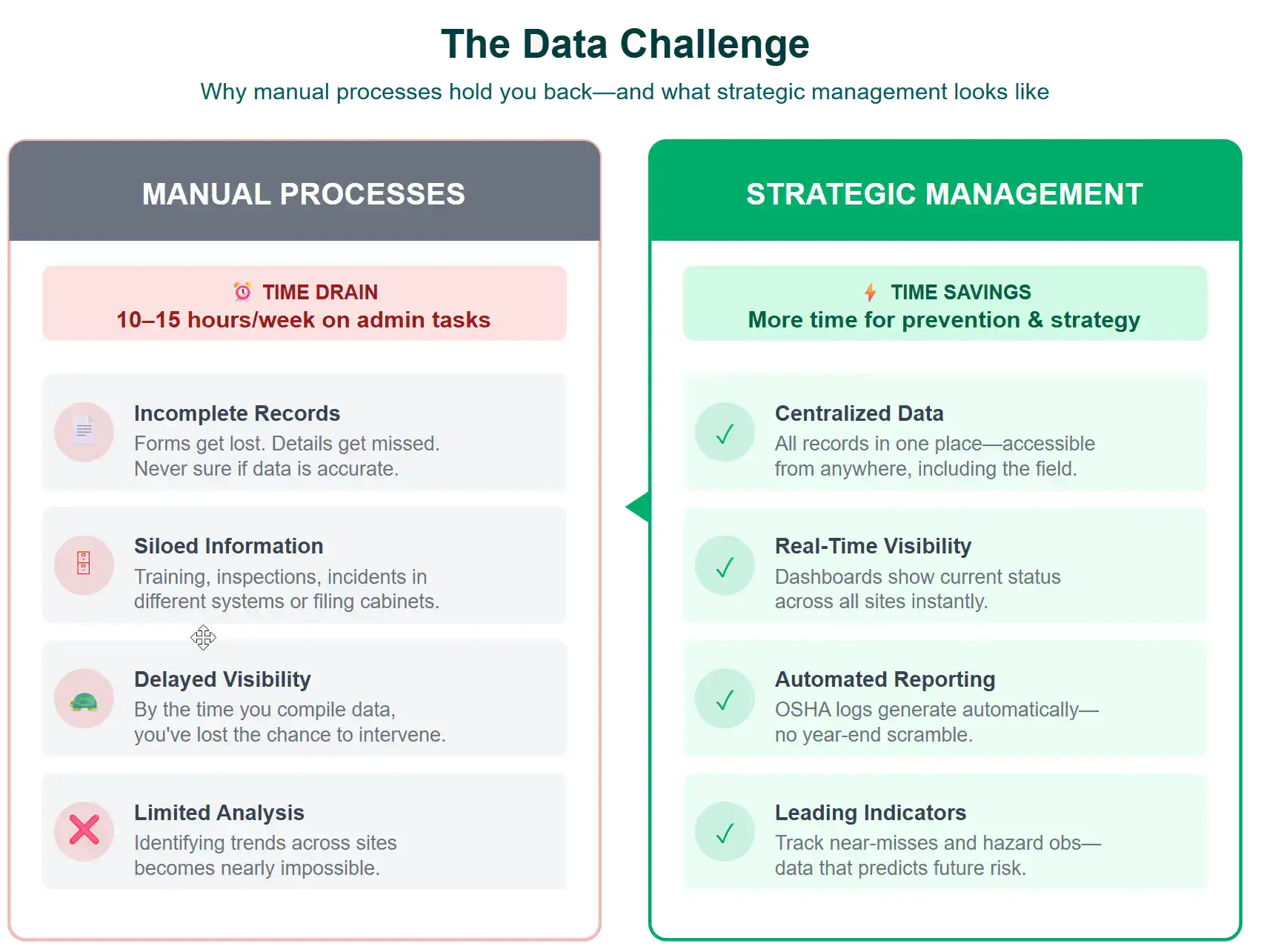
Safety professionals who spend less time chasing paperwork spend more time preventing incidents—and building careers.
“When a customer audits us, we’re able to quickly and easily pull how many hours of training we’ve provided on specific topics. No paper to sift through and no more Excel sheets to maintain. We’re talking about countless hours saved.”
-Janise Black, Data Analyst, 3S Services
Making the Shift: What Strategic Safety Management Looks Like
The safety leaders who advance in their careers share a few common practices. They’ve moved beyond paper-based compliance into a more proactive, data-driven approach:
Centralized data. All incident reports, inspections, training records, and corrective actions live in one place—accessible from anywhere, including the field.
Real-time visibility. Dashboards show current status across all sites, so you can spot emerging issues before they become recordable incidents.
Automated reporting. OSHA logs and summaries generate automatically from incident data you’ve already captured, eliminating the year-end scramble.
Leading indicators. Beyond lagging metrics like TRIR, they track near-misses, hazard observations, and training completion rates—data that predicts future risk.
Executive-ready insights. Reports are designed to communicate with leadership, not just satisfy regulators. That means clear visuals, trend analysis, and business impact framing.
Positioning Yourself for Advancement
Career advancement in safety doesn’t happen by accident. It requires intentionally positioning yourself as someone who understands the business—not just the regulations.
Here’s how OSHA reporting season can support that positioning:
Schedule a Leadership Presentation
Don’t just post the 300A and call it done. Request time with your leadership team to walk through your annual safety performance. Come prepared with insights, trends, and recommendations. This visibility matters.
Quantify Your Impact
Whenever possible, translate safety outcomes into financial terms. A 20% reduction in recordable incidents sounds good. But a $150,000 reduction in projected worker’s compensation costs? That speaks leadership’s language.
“Management quickly sees huge savings, direct dollars. Workers’ comp claims started dropping off and we got huge windfalls back from our workers’ comp insurance company. Ex-mod dropped from 1.23 to .95. So, now management is comparing workers’ compensation, insurance, reserves, and direct cost of people being out and replacing them to our numbers pre-Novara, and it’s night and day.”
–Steve Pelkey, EHS Corporate Director, Western Pneumatics
Propose a Proactive Initiative
Use your data to identify one area where targeted investment could make a measurable difference. Maybe it’s a behavior-based safety program for your highest-risk department. Maybe it’s mobile inspection tools to improve consistency across sites. Whatever it is, tie it to specific data points.
Document Your Wins
Keep a running record of the initiatives you’ve led and the outcomes they produced. When performance review time comes—or when a promotion opportunity opens—you’ll have concrete evidence of your contributions.
This Year’s Reporting Season: An Action Plan
Ready to approach OSHA reporting differently this year? Here’s a practical framework:
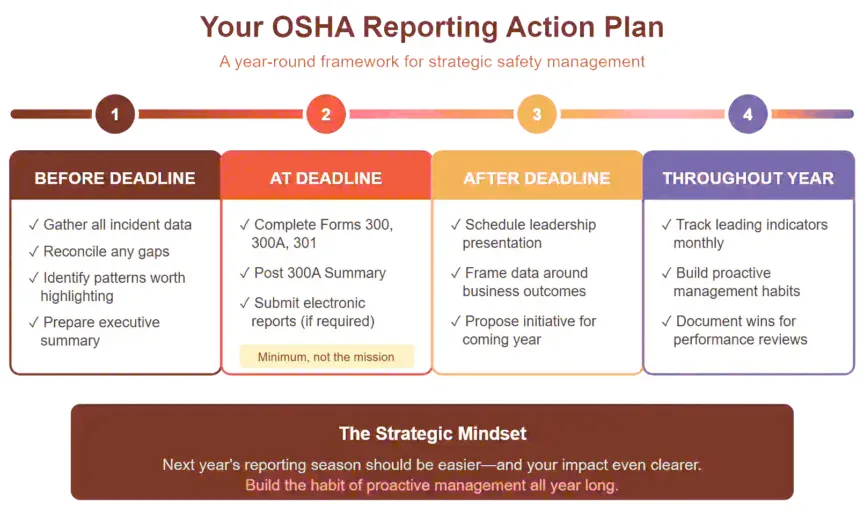
Before the deadline: Gather all incident data and reconcile any gaps. Identify any patterns worth highlighting. Prepare both your compliance documents and an executive summary that tells the bigger story.
At the deadline: Complete and post your 300A as required—but treat it as the minimum, not the mission.
After the deadline: Schedule time with leadership to present your annual safety performance. Frame your data around business outcomes. Propose at least one initiative for the coming year, backed by evidence from your analysis.
Throughout the year: Track leading indicators monthly, not just lagging metrics annually. Build the habit of proactive management so next year’s reporting season is easier—and your impact is even clearer.
Your Career Is Worth the Investment
OSHA compliance will always be part of your job. But it doesn’t have to define the ceiling of your career.
The safety professionals who advance are the ones who treat compliance data as business intelligence. They present insights that matter to leadership. They propose solutions backed by evidence. And they position themselves as strategic partners in protecting both people and the bottom line.
This reporting season, don’t just meet the deadline. Use it to show what you’re really capable of.