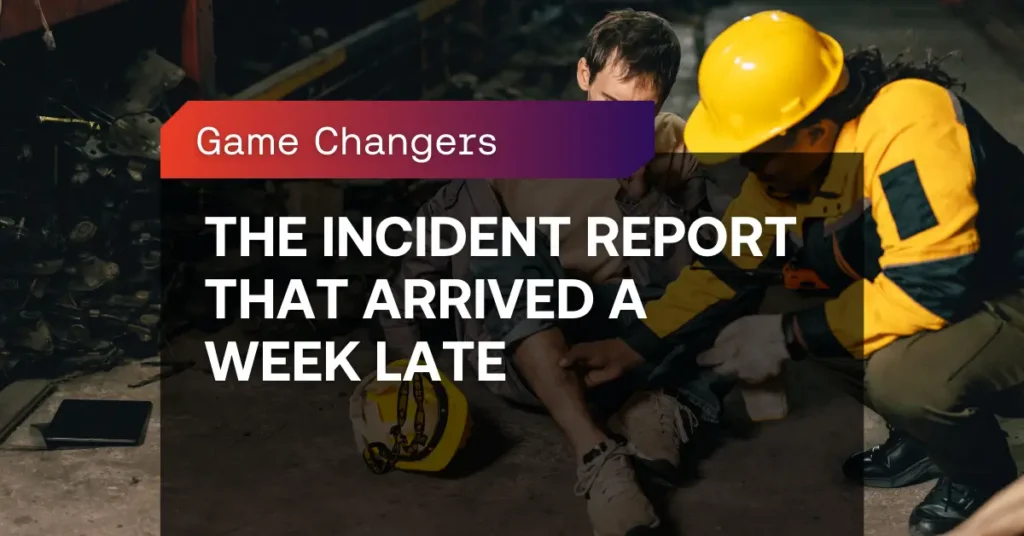
When a worker goes down on a Silvi Materials job site, the plant supervisor doesn’t get to stop what they’re doing. They’re arranging emergency response. Coordinating drug testing. Keeping production from grinding to a halt. Managing the human chaos that follows any serious incident.
And somewhere in the middle of all of that — someone is expecting a detailed written report.
For years, that expectation went unmet. Reports arrived days later, assembled from fragmented memory and secondhand accounts. Sometimes they arrived a week late. Sometimes they didn’t arrive at all.
Colby Ankeny, Director of HSE at Silvi Materials, didn’t accept that as inevitable. He found a better way — and the results speak for themselves.
The Week-Long Report Problem Nobody Talks About
Picture the scenario: an employee is injured at a Silvi batch plant. The plant supervisor is the first person on scene. Within the next 60 minutes, they’re simultaneously managing the injured worker, contacting HR, coordinating a post-incident drug test, fielding calls from operations, and trying to keep concrete production running on schedule.
Writing a detailed incident report in that moment isn’t laziness — it’s physically impossible.
So what happened instead? The report got pushed to later. Later became tomorrow. Tomorrow became next week. And when it finally arrived, it was reconstructed from memory — missing the exact sequence of events, the environmental conditions at the time, the witnesses who were present, the photos that should have been taken at the scene.
“Sometimes I wouldn’t get the report for a week or two, or people would forget about it,” says Colby. “This corrected that.”
The problem isn’t unique to Silvi. It’s endemic to construction, manufacturing, and any field-intensive industry where the people responsible for reporting are the same people managing the aftermath. The question is whether your organization has decided to live with it — or fix it.
What Gets Lost When You Wait (And Why It Matters)
Delayed incident reports aren’t just an administrative inconvenience. They carry real risk across three dimensions that EHS leaders understand well:
Accuracy degrades fast.
Human memory is unreliable under stress, and the details that matter most in an incident investigation — exact location, time of day, what was observed immediately before the event, who was present — fade within hours. A report filed a week later isn’t a record. It’s a reconstruction.
Compliance windows don’t wait.
OSHA recordability requirements, state workers’ comp reporting deadlines, and internal escalation protocols all operate on tight timelines. A report that arrives a week late may already be a compliance failure before anyone reads it.
Corrective actions get delayed.
If you don’t know what happened until seven days after it happened, you can’t address the underlying cause for at least a week. The same hazard is still present. The same conditions that produced one incident can produce another — and often do.
The Incident Reporting Gap
Why reports filed from memory days later aren't records — and what Silvi Materials did about it.
reached Colby's desk — before Novara Flex
to mobile incident reporting with Novara Flex
How Colby Sold Mobile Reporting to Operations — Without Making Enemies
Getting operations teams to adopt a new reporting process is its own challenge. Change management in field environments is notoriously difficult, and any initiative that looks like surveillance will be met with resistance — or quiet non-compliance.
Colby understood this going in. His rollout strategy wasn’t built around compliance requirements or management mandates. It was built around a simple, honest value proposition for the people actually doing the work.
That framing — less work for you, not more oversight of you — is what drove adoption across a 1,000-person workforce.
When Colby introduced Novara Flex, he promised his team something concrete: that they’d be able to report incidents from their phones, in the moment, without hunting for a computer or reconstructing events from memory later. “I promised them something that they’d be able to use on their phones, kind of in the heat of battle,” Colby says.
The results of that approach are visible in Silvi’s reporting numbers. As the company’s injury rate fell 80%, its volume of reported events climbed 60%. That’s not a contradiction — it’s a sign of a reporting culture that actually works. Workers aren’t suppressing near-misses to keep numbers clean. They’re reporting everything, because reporting is easy and they believe it leads to action.
Report It at the Scene: The Mobile Difference
What does real-time mobile incident reporting actually look like in practice? At Silvi, a supervisor or employee opens Novara Flex on their phone or tablet. They fill out a first report of incident form — built specifically for Silvi’s operations, not a generic template — and submit it from the field, while the details are still fresh.
That form captures everything the investigation needs: the time and location, a description of what happened, who was involved, photos of the scene, the type of incident. It does this in a format that’s fast enough to complete in the field, even when a supervisor is managing five other things simultaneously.
And when the form is submitted, the work doesn’t stop at an inbox waiting for someone to manually route it. It triggers a workflow automatically.
How Smart Workflows Eliminate the Ownership Debate
Multi-plant operations create a specific accountability problem that anyone managing distributed teams will recognize immediately. When an incident involves workers from different locations, or happens at a site where no single manager has clear authority, the question of ownership can remain unanswered for days.
Novara Flex’s workflow engine solves this by removing human judgment from the routing decision. When a first report of incident is submitted, the platform looks at the incident type and the employee record — not geography, not who happened to respond first — and routes it to the correct supervisor automatically.
Injury? That triggers a full incident investigation workflow, assigned to the employee’s direct manager. Motor vehicle accident? A different form, a different path. Something anomalous? That routes directly to Colby — bypassing the standard chain of command entirely.
“If you select ‘other,’” Colby explains, “that actually comes directly to me. It skips the plant managers, the region managers, the director levels — it goes around everybody and comes straight to me.”
No debate. No delay. No three-day email thread about who owns the report.
What “In the Heat of Battle” Really Means for EHS Leaders
There’s a concept embedded in everything Colby describes that’s worth naming directly. The phrase he uses — “in the heat of battle” — isn’t just colorful language. It’s a precise description of the operational reality that makes paper-based and desktop-first reporting systems fail.
Construction and field operations don’t have quiet moments. An injury on a batch plant is happening during a production shift. An MVA is happening on a live job site. A near-miss occurs during the same window that three other things are going wrong. The “heat of battle” is not an exceptional circumstance — it’s Tuesday.
Any EHS system that requires a supervisor to step away from the scene, find a computer, log in, and complete a form in a calm environment will produce the same outcome Colby experienced before Novara Flex: reports that arrive late, incomplete, and assembled from memory.
The Reporting Paradox – And Why It’s a Good Sign
Since Silvi implemented Novara Flex, reported incident volume has gone up 60% — while injury rates have gone down 80%. That’s not a contradiction — it’s the signature of a safety culture that actually works. When reporting is easy and workers believe it leads to action, they report everything. The data gets more accurate. The picture gets clearer. As Colby puts it: “It was always happening. You just didn’t know.”
The fix isn’t complicated in concept, but requires the right tool.
Mobile-first incident reporting captures data at the scene, in the moment, before any detail has a chance to fade. It works on the phone a supervisor already has in their pocket. It doesn’t ask them to pause the emergency to file a form — it gives them a form fast enough to complete while managing the emergency.
For Silvi’s 30-plus sites and 1,000-person workforce, this wasn’t a nice-to-have upgrade. It was the difference between a safety program that ran on memory and one that ran on data.
Related Content
Explore more comprehensive articles, specialized guides, and insightful interviews selected, offering fresh insights, data-driven analysis, and expert perspectives.