
OSHA can now walk onto your site on any day the National Weather Service issues a heat advisory or warning. No complaint required. No prior incident. No formal notice — just a forecast. Under the expanded Heat-Related Hazards National Emphasis Program, the weather itself is grounds for a random inspection.
This isn’t a minor update. Issued April 10, 2026, the revised NEP pushed the target list from 33 industries to 55, reaching past construction and agriculture into retail, warehousing, transportation, and restaurants.
Compliance officers now work from an 11-point checklist and document ambient conditions on every visit — heat index, wind speed, humidity, active weather alerts. The program runs through 2031. That’s a five-year enforcement posture, not a seasonal push.
The old defense doesn’t hold anymore, either. “We haven’t had an incident” was never a real safety strategy, but it used to at least keep inspectors off your site. Now a hot forecast does the same job a complaint used to do.
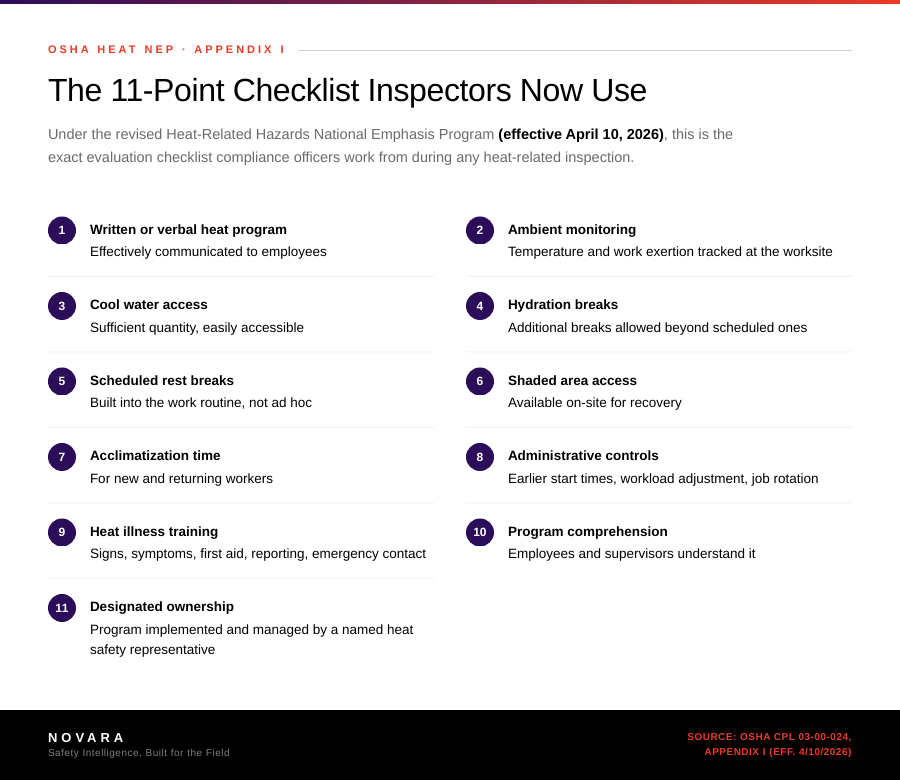

Heat Illness Checklist
Are you doing enough to keep your employees safe from summer heat? Get this helpful checklist with some practical ways to plan for and prevent heat-related illnesses at your business.
The federal heat standard itself remains stalled with no target date and isn’t considered an administration priority — the proposed rule has sat in post-hearing comment review since October 2025 with no finalization in sight. That gap used to give employers room to wait. It doesn’t anymore. As Zach Pucillo, EHS Regulatory Compliance Manager at KPA, put it on a recent Novara webinar: “Safety leaders can move faster than regulations can. If you don’t have a heat illness policy because the federal rule hasn’t come out, that doesn’t mean you can’t put one in now.” Waiting on Washington was never the plan. In 2026, it’s actively the wrong one.
And Washington isn’t the only jurisdiction in play. California, Oregon, Maryland, and Nevada all run active indoor/outdoor heat rules, and Colorado’s new agricultural heat standard took effect February 1, 2026. Multi-state employers are reconciling five separate heat compliance frameworks this summer, on top of a federal NEP that applies regardless of where those state rules stop.
The Hazard With No Federal Standard At All
Heat has an enforcement program, even without a finalized rule behind it. Wildfire smoke doesn’t have either. Federal OSHA has no wildfire smoke standard — none. Employers get General Duty Clause guidance and voluntary respirator recommendations. That’s the entire federal position.
California and Oregon have filled the gap themselves. California’s DIR requires PM2.5 monitoring, worker communication, and NIOSH-approved respirators for voluntary use once the AQI crosses 151 — thresholds the state has activated repeatedly this season amid the Springs and Crown fires. Oregon runs its own AQI-based rule. Everywhere else, 48 states are working from patchwork guidance during a season when smoke events are stretching longer and landing in places that never used to plan for them.
For any employer west of the Rockies, this isn’t two separate hazards to track. It’s one overlapping exposure window: peak heat enforcement and peak smoke risk, landing in the same July, on the same crews.
What To Put In Place Now
Three moves close most of the gap, and none of them require a federal rule to exist first:
1. Write the heat illness prevention program today, regardless of what your state requires.
Hydration protocols, acclimatization schedules for new and returning workers, shade access, and a clear emergency response procedure for heat illness — spelled out, not assumed.
2. Start documenting ambient conditions the same way inspectors will.
Heat index, humidity, active alerts, logged per shift, per site. If OSHA can build a file on you from the weather report, you should already have a matching one.
3. Build a wildfire smoke response protocol even though no federal rule demands it.
Set your AQI trigger points, communication steps, and respirator access before smoke season peaks, not while it’s happening.
4. Map your state overlap if you operate across more than one.
Five states now run their own heat rules on top of the federal NEP — know which one applies at each site before an inspector tells you.
The Bottom Line
Federal deregulation isn’t a green light. The General Duty Clause still applies, and enforcement is already proving it — with checklists, documented conditions, and inspection authority that no longer waits for an incident. The employers who come out of this season clean will be the ones who wrote the policy before the inspection, not after it.
Ready to close the gap?
Novara’s platform keeps heat advisories, ambient conditions, and respiratory protocols in one auditable record — built before the inspector shows up, not scrambled together after.
Related Content
Explore more comprehensive articles, specialized guides, and insightful interviews selected, offering fresh insights, data-driven analysis, and expert perspectives.