Why EHS Programs Stall: The Real Reason Safety Programs Lose Momentum

The program looks good on paper. Training is assigned. Incident forms exist. Inspections are scheduled. There’s a process for reporting near-misses and a spreadsheet for tracking corrective actions.
But something isn’t working.
Completion rates lag. Findings sit open for weeks. Walk onto three different sites and you’ll find three slightly different versions of how things get done. Leadership keeps asking for status updates that take hours to compile. And somewhere in the back of every Safety Director’s mind is the knowledge that the program is moving slower than the risk.
When this happens — and it happens in a lot of otherwise well-run organizations — the instinct is to look at the people. Workers who don’t complete training. Supervisors who don’t enforce the process. Site managers who do things their own way.
That instinct is understandable. It’s also usually wrong.
The gap between a safety program that performs and one that stalls is almost never a people problem. It’s a systems problem. And the difference matters — because the solutions are completely different.
The Accountability Illusion
Most safety programs aren’t designed with accountability built in. They’re designed with accountability assumed.
A corrective action gets assigned. Someone writes it down, or enters it in a spreadsheet, or sends an email. The expectation is that the person on the other end will remember, follow up, and close it out. If they do, great. If they don’t, the action sits open until someone notices.
This isn’t a failure of individual discipline. It’s a failure of system design.
Accountability requires infrastructure — not just intent. When follow-through depends on individual memory, email inboxes, and manual check-ins, the system is one missed reminder away from a gap. Multiply that across a team, a site, or multiple locations, and you don’t have one open corrective action. You have dozens. Maybe more.
High-performing safety programs don’t rely on people to remember. They rely on systems that route assignments automatically, send reminders, escalate overdue items, and make the status of every open action visible to anyone who needs to see it. When the system does that work, people can focus on the actual work of closing the loop.
Accountability requires infrastructure — not just intent.
The question isn’t whether your team is responsible. It’s whether your system is set up to support them.
Your Highest-Risk Workers Are Your Hardest to Train
Here’s a reality most EHS leaders know but rarely say out loud: the workers with the greatest physical risk exposure are also the hardest to reach with training.
Frontline workers in manufacturing, construction, and industrial environments don’t spend their days at a desk. They’re on the floor, on a site, operating equipment, moving between locations. If completing required training means finding a computer, attending a scheduled in-person session, or waiting for a training window that fits around production schedules — workers fall behind. Not because they don’t care. Because the training wasn’t designed for the way they actually work.
Training that requires a desk doesn’t serve a workforce that doesn’t have one. That’s not a motivational failure. It’s a design failure.
The gap shows up in completion data that looks like disengagement but is really friction. Workers who would complete training if it were accessible on their phone, in a short-form format, during a natural break in the workday. Organizations that close this gap don’t do it through mandates or escalation. They do it by removing the barriers that made completion harder than it needed to be.s automatically, send reminders, escalate overdue items, and make the status of every open action visible to anyone who needs to see it. When the system does that work, people can focus on the actual work of closing the loop.
Training that requires a desk doesn’t serve a workforce that doesn’t have one.
Mobile-first training access isn’t a nice-to-have. For industrial and field-based workforces, it’s the baseline requirement for a training program that actually works.
Three Sites, Three Programs — And No One Planned It That Way
Ask most Safety Directors whether they have a standardized safety program and they’ll say yes. Ask them whether every site runs the same inspections, uses the same forms, follows the same corrective action process, and applies the same training requirements — and the answer gets more complicated.
In most organizations, standardization exists in intention more than in practice. The program is designed at headquarters and implemented at the site level, which means the actual execution depends on how the local supervisor interprets the process, what technology is available, and what the established site culture happens to be. Over time, three sites that were supposed to be running the same program are running three slightly different versions of it.
This creates two distinct problems.
1. Uneven worker protection.
When process quality varies by location, workers at some sites are being asked to operate in safety programs that are meaningfully weaker than others. That’s not a visible disparity, but it’s a real one.
2. Invisible exposure.
When your program operates differently at each location, it’s nearly impossible to identify where the program is strongest and where it’s most at risk. The absence of a consistent baseline means the absence of a reliable signal.
Standardization is sometimes framed as an operational efficiency goal. It is. But it’s also a cultural statement: every worker in this organization operates under the same protections, the same expectations, and the same process. That consistency is what turns a safety program into a safety culture. Inconsistency, even when unintentional, creates different classes of protection — and erodes worker trust in the program over time.
What Changes When the Friction Disappears
When the infrastructure is right — when reporting is easy, training is accessible, corrective actions route themselves, and leaders have visibility without having to compile it manually — something interesting happens to the program’s leading indicators.
Near-miss reporting goes up.
Not because more incidents are happening, but because the friction to report has dropped. Workers who previously didn’t bother because the form was on paper or the process felt bureaucratic are now logging hazards from their phone in under two minutes. More reports means more signal. More signal means earlier intervention.
Corrective actions close faster.
Because they’re automatically assigned, tracked, and escalated when they’re overdue — not dependent on someone remembering to follow up.
Leaders spend less time assembling status reports and more time acting on what the data tells them.
The program stops feeling reactive and starts feeling like it’s actually ahead of the risk.
None of this requires heroics from individual team members. It requires a system that does what systems are supposed to do: make the right behavior the easy behavior, and make accountability visible rather than assumed.
Systems Before Blame
Safety culture isn’t built through messaging or mandates. It’s built through systems that make participation easy, accountability visible, and follow-through automatic.
If your program is stalling — if completion rates are lagging, findings are going unresolved, or sites are drifting from a consistent standard — look at the system before you look at the people. The people are usually doing the best they can with what they’ve been given.
The question is whether what they’ve been given is designed to work.
Built for This Problem
Novara Flex is built to be the infrastructure that most safety programs are missing. One platform replaces the spreadsheets, paper binders, and disconnected point solutions that create the gaps described above — giving frontline workers the tools to participate and leaders the visibility to act.
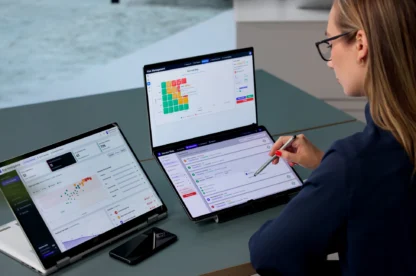
Mobile-first inspection and incident reporting means workers can log hazards, complete training, and flag near-misses from wherever they’re working — no desk required. Automated corrective action routing means follow-through doesn’t depend on someone remembering to follow up. Standardized digital forms and workflows mean every site runs the same program, not a local variation of it. And real-time dashboards give safety leaders a live picture of program health across all locations, without assembling it manually.
Accountability becomes a function of the platform, not of individual effort. That’s the difference between a program that runs on good intentions and one that actually performs.