Focus Your Sustainability Strategy on What Matters Most
Novara Flex Sustainability makes materiality assessment easy. With Flex, you can identify which environmental, social, and governance issues matter most to your business, then prioritize them so you know where to spend time and money.
Bring potential topics, stakeholder feedback, industry context, and final priorities into one connected process. Then turn your findings into measurable goals, programs, metrics, and disclosures across Novara Flex Sustainability.
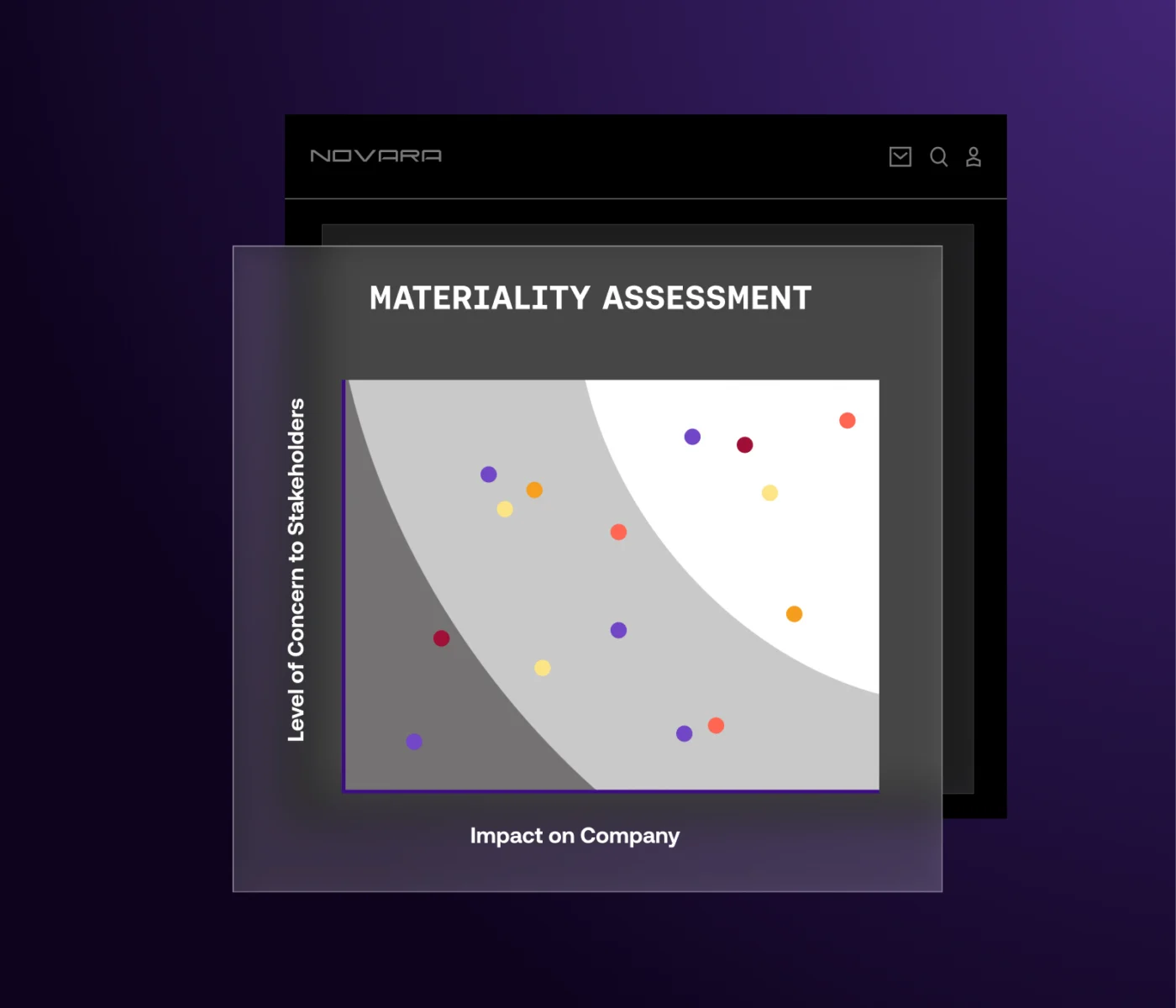
Build a Clear, Defensible View of What Matters
A materiality assessment should tell you where to put resources, which risks need attention, and how sustainability priorities connect to the business. Novara Flex Sustainability runs the process end to end — topic selection, stakeholder engagement, scoring, and review.
Work from a library of more than 100 environmental, social, and governance topics, each mapped to the applicable United Nations Sustainable Development Goals and ready to be aligned to your reporting frameworks.
Begin broad, narrow by industry and operation, and keep a record of everything you considered, including what you ruled out and why.
Collect input from the people who influence or are affected by your sustainability strategy, including employees, customers, investors, suppliers, community partners, and leadership.
Centralized surveys and structured workflows make it easier to gather feedback, compare perspectives, and document how stakeholder input shaped the final assessment.
Traditional materiality asks what affects your business. Double materiality asks that as well as the inverse: what your business affects.
For example, a traditional assessment would ask how environmental issues affect your financial position. In a double materiality assessment, you’d also look at how your operations affect the environment. These external-facing assessments are important for regulatory reports and can resonate with customers, employees, and local communities.
Most organizations need both views. Flex Sustainability scores each topic across both considerations and keeps the reasoning behind every score.
Use AI-enabled peer benchmarking to compare your material topics with industry context. Identify potential gaps, validate emerging priorities, and add external perspective to internal and stakeholder input.
How it works
How a Materiality Assessment Works in Flex
Flex Sustainability provides a structured process for conducting and maintaining your assessment.
1. Define the scope
Set the business units, geographies, operations, value-chain activities, and reporting boundaries the assessment covers.
2. Identify potential topics
Build the initial list from the topic library, industry research, reporting requirements, business risks, and prior assessments.
3. Select stakeholders
Choose the internal and external groups whose perspectives should carry weight.
4. Collect and analyze feedback
Distribute surveys, gather responses, and consolidate the supporting information.
5. Evaluate and prioritize
Score each topic on stakeholder importance, business impact, financial implications, and environmental or social effect.
6. Integrate the results
Connect material topics to goals, programs, metrics, risk management, and disclosure activities.
7. Monitor and reassess
Revisit priorities as the business, expectations, and requirements change.
Built to Evolve
Keep Materiality Current
What’s material today shifts when you enter a market, acquire a business, extend the supply chain, launch a product, or face a new stakeholder expectation.
Flex Sustainability tracks material and emerging issues between formal assessments. Update assessments, revisit stakeholder input, and adjust priorities without starting over with a new set of spreadsheets and documents.
Flex turns materiality into a process that moves with the business instead of a project you repeat from scratch.
Add Context Without Adding More Manual Work
Embedded AI helps sustainability teams evaluate more information and identify potential gaps without increasing administrative burden.
Use AI-enabled capabilities to:
Your team remains in control of the final assessment, priorities, and business decisions.
Why Novara Flex Sustainability?
With Flex Sustainability, your team can:
Novara Flex Sustainability supports CDP, SASB, TCFD, the UN SDGs, SEC, EU CSRD, EU ESRS, and IFRS.
Frequently Asked Questions
A sustainability materiality assessment is a structured process for identifying and prioritizing the environmental, social, and governance issues that are most significant to an organization and its stakeholders. The results determine where the organization should focus its strategy, programs, measurement, and reporting.
A double materiality assessment evaluates sustainability topics from two perspectives. Financial materiality considers how sustainability risks and opportunities may affect the organization’s financial performance, position, or prospects. Impact materiality considers how the organization’s activities affect people, communities, and the environment. Together, these perspectives provide a more complete view of sustainability priorities—and are required under frameworks such as the European Sustainability Reporting Standards (ESRS).
| Financial materiality | Impact materiality | |
| Question | How do sustainability issues affect our financial position? | How do our operations affect people and the environment? |
| Audience | Investors, lenders, boards | Regulators, communities, employees, customers |
| Example | Carbon pricing raising operating costs | Facility emissions affecting local air quality |
| Required by | IFRS S1 and S2 | CSRD, ESRS |
Participants commonly include employees, executives, customers, investors, suppliers, business partners, community representatives, and other groups affected by or interested in the organization’s operations. The appropriate stakeholders depend on the organization’s industry, footprint, value chain, and assessment objectives.
Organizations should review material topics regularly and reassess them when significant changes occur — including acquisitions, divestitures, new markets, operational expansions, regulatory developments, or shifts in stakeholder expectations. Novara Flex Sustainability helps teams monitor topics between formal assessments and maintain a record of how priorities change over time.
Materiality determines which topics receive the greatest attention in sustainability strategy and disclosures. Novara Flex Sustainability connects material topics to supporting goals, metrics, programs, source data, and reporting workflows — creating a clear link between what the organization prioritizes and how it manages performance.
The European Sustainability Reporting Standards (ESRS), which underpin the Corporate Sustainability Reporting Directive (CSRD), require a double materiality assessment. Organizations subject to CSRD must assess both financial and impact materiality to determine which sustainability topics to disclose.
A single materiality assessment evaluates topics only from the perspective of financial significance to the organization. A double materiality assessment adds a second lens: the significance of the organization’s own impacts on people and the environment. Double materiality is better suited for organizations that need to comply with ESRS or CSRD, while single materiality may be sufficient for frameworks such as SASB or TCFD.
Build Your Sustainability Strategy Around What Matters Most
See how Novara Flex Sustainability can help you identify material topics, engage stakeholders, prioritize action, and connect your ESG materiality assessment to measurable sustainability performance.