OSHA Top 5 for Construction
Every year, thousands of preventable incidents occur, causing needless injuries, illnesses, and—in some cases—deaths. From OSHA penalties to workers compensation claims to legal, operational, and reputational costs, businesses pay a significant toll.

How to avoid the most frequently cited violations
OSHA Citations–they’re rampant, they hide in plain sight, and they have potentially dire consequences for your people and your bottom line. Is your organization doing enough to avoid the most common Occupational Safety and Health Administration (OSHA) citations?
No matter how much you know (or think you know) about the most common workplace violations out there, it’s clear that organizations could use some help.
In 2023, construction companies paid over $106 million dollars in penalties for OSHA violations.
The top violations were:1
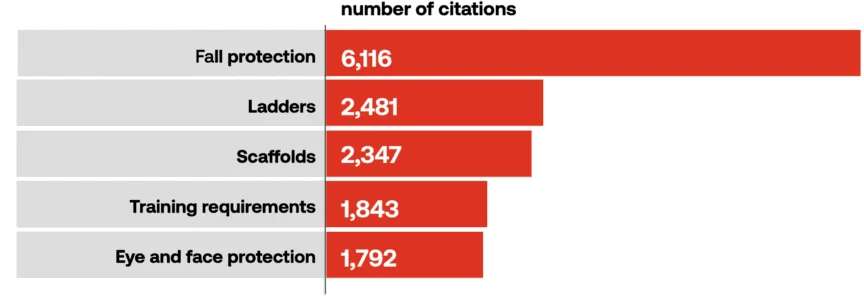
This list has remained largely unchanged for a decade. The reality is undeniable: many environment, safety, and health professionals are failing to adequately recognize and mitigate the greatest sources of workforce risk.
Every year, thousands of preventable incidents occur, causing needless injuries, illnesses, and—in some cases—deaths. From OSHA penalties to workers compensation claims to legal, operational, and reputational costs, businesses pay a significant toll.
Don’t let your employees or your organization become statistics. In this resource, you’ll learn how to avoid the 5 most frequently cited OSHA standards in the construction industry, one by one. The following pages contain explanations of each hazard, along with warning signs to look out for and prevention checklists you can use to improve compliance and minimize losses.
But before we begin, let’s take a closer look at what’s at stake—the price your organization pays when these hazards go unaddressed.
Every year, thousands of preventable incidents occur, causing needless injuries, illnesses, and—in some cases deaths.
The Cost of an OSHA Violation
OSHA penalties can exceed $16,131 per violation and as much per day for every day the issue hasn’t been fixed by OSHA’s deadline.
The fine for a willful or repeated violation can be 10 times as much. In 2024, the maximum penalty for such a violation is $161,323. 2
And those are just the direct costs. Organizations that don’t adequately address common workplace hazards can expect to pay hundreds of thousands—even millions—in indirect expenses.
Of course, the true costs of a safety violation are incalculable. No one can put a number on an employee’s life. Suffice it to say, it’s in your organization’s best interest to bring your annual number of injuries and illnesses to zero.
Fortunately, avoiding an OSHA citation isn’t as complex or cost-intensive as many people think. Small steps can save you 6 or 7 figures—or even save someone’s life.
Read on to learn about the 10 most common OSHA violations and what you can do today to reduce their chances of happening in your workplace.
Examples of indirect workplace hazards expenses
Fall Protection and Ladders
The OSHA Standard
OSHA definition:
OSHA’s Subpart M addresses the requirements and criteria for fall protection in construction workplaces. It applies when workers are working at heights of 6 feet or more above a lower level. The provisions of Subpart M can be found in Title 29 Code of Federal Regulations (CFR) Subpart M – Fall Protection, 29 CFR 1926.500, 29 CFR 1926.501, 29 CFR 1926.502, and 29 CFR 1926.503.
Simple definition:
When construction workers are performing work at heights of 6 feet or more they must be protected from falling.
OSHA’s Top of the Tops
When looking at OSHA’s top 10 most cited standards in 2023 the clear winner for most violations goes to fall hazards on roofs, scaffolds, lifts and ladders. And not surprisingly, for the 13th year in a row fall protection was the most frequently cited OSHA violation.
Historically, falls are the leading cause of fatalities in construction, and they account for about onethird of all fatalities in the construction industry. The vast majority of the fall fatalities are to lower levels. The Bureau of Labor Statistics (BLS) reported that of the 5,486 worker fatalities in the US in 2022, 1,056 occured in the construction industry and estimate that over 400 of those deaths were the result of a fall. BLS estimates that eliminating fall hazards in construction would save approximately 300 lives annually. Workers who are most at risk are laborers, roofers and carpenters.
OSHA recognizes that fall incidents are typically complex events that can involve a variety of factors. OSHA’s standard for fall protection addresses both human factors as well as equipment-related issues in its effort to protect workers from fall hazards.
Why Fall Protection Violations Happen
Fall protection violations are very common because construction workers are frequently exposed to fall hazards when working on rooftops, openings on sides of buildings, scaffolding, mobile elevated work platforms (lifts), ladders and other heights. According to the BLS, of the 5,486 worker deaths in 2022, 865 were the result of a slip, trip and fall accident.
Some common causes of fall protection violations include:
Signs You’re at Risk of Fall Protection Violation
You work in construction: Working at heights is extremely common in the construction industry. Anytime a worker is working at 6 feet or more near unprotected openings and edges there is a risk of falling. And the farther the fall, the more dangerous the outcome.
Your workforce hasn’t been trained properly or consistently: Every worker who works at heights needs to understand the risks of a fall and what measures must be put into place to prevent them from falling. Training should be conducted annually.
How to Avoid a Fall Protection Violation: Your Prevention Checklist
Personal Fall Arrest System
Guardrail Systems
Ladders
Scaffold
Holes
Training
Scaffolding
The OSHA Standard
OSHA definition:
OSHA’s scaffolding rules “[aim] to protect workers using scaffolding
in construction work. Scaffolding hazards continue to rank high on the list of the most
frequently cited standards in the construction industry. Scaffold-related fatalities account
for a significant number of fatalities in the construction workplace.”9
Simple definition:
A scaffold is a temporary structure that allows people to work in areas
that are high off the ground or otherwise inaccessible. OSHA’s scaffolding standards lay
out safe and proper methods for scaffolding used in construction jobs.
There are three types of scaffolds commonly used:
OSHA’s scaffolding standard covers each of these kinds of scaffolds, as well as ladders, stilts, protection from falling objects, weather conditions, and other related hazards. The standard is extensive and detailed, specifying everything from fall protection measures to guardrail height to inspections and training.
Why Violations Happen
Scaffolding violations are common because scaffolds are standard construction equipment. The majority (65%) of construction projects involve scaffolds, according to the Bureau of Labor Statistics. 10 Millions of construction workers across the US work on scaffolds every year. The BLS estimates that 3 issues account for over 70% of all scaffolding accidents:
Overall, most scaffolding violations are the result of faulty equipment, dangerous environmental conditions, improper training, or a combination thereof.
Signs You’re at Risk
How to Avoid a Scaffolding Violation: Your Prevention Checklist
Personal Protective Equipment – Eye and Face Protection
The OSHA Standard
OSHA definition:
“Thousands of people are blinded each year from work-related eye injuries that could have been prevented with the proper selection and use of eye and face protection.
OSHA requires employers to ensure the safety of all employees in the work environment. Eye and face protection must be provided whenever necessary to protect against chemical, environmental, radiological, or mechanical irritants and hazards.
Personal protective equipment, commonly referred to as ‘PPE,’ is equipment worn to
minimize exposure to hazards that cause serious workplace injuries and illnesses. These injuries and illnesses may result from contact with chemical, radiological, physical, electrical, mechanical, or other workplace hazards.”14 15
Simple definition:
Personal protective equipment (“PPE” for short) is exactly what it sounds like: equipment people wear on their bodies to protect themselves. OSHA requires workers to wear PPE whenever they could become injured or sick by not wearing it.
There are many different kinds of PPE, with each piece designed for a specific job or working condition. Common examples of PPE include hard hats, safety glasses, goggles, face shields, gloves, steel-toed boots, respirators, earplugs, vests, coveralls, and other full body suits. PPE needs to fit comfortably and properly, or else it may not work as intended. It must be regularly inspected and maintained, and replaced when no longer functional. Employers must supply and pay for all PPE necessary to keep their employees safe.
Of all the body parts that PPE protects, the face and eyes are among the most vulnerable. Many safety incidents involve a worker’s face or eyes getting struck by an object, injured by flying particles, burned by acids or chemicals, or exposed to light radiation.
Why Violations Happen
Simply put, eye and face protection violations occur because the eyes and face are often under-protected and overexposed.
Workers and their employers frequently underestimate the risk of eye and face injuries. Employees may neglect to wear eye and face protection or remove their PPE before it is safe to do so. Common complaints are that the PPE doesn’t fit comfortably, is too hot, or makes the wearer look unattractive. For goggles and safety glasses in particular, a major problem is the equipment fogging up16, causing the wearer to periodically remove it and clean off moisture.
One of the leading reasons for PPE violations is inaccessibility—the right equipment isn’t readily available when people need it. Sometimes, violations occur because the employer has failed to provide the necessary PPE. Now and then, violations occur because PPE hasn’t been stored or maintained properly.
Then, as usual, there’s the issue of inadequate training. Workers need to know when and how to use PPE; how to put it on, adjust it, and take it off; and how to properly test, store, maintain, and dispose of the equipment.
Signs You’re at Risk
- You work in a high-risk industry: PPE violations happen in myriad different environments, but they’re perhaps most common in the construction, manufacturing, and repair industries.
- You haven’t conducted a hazard assessment: OSHA requires employers to identify any and all hazards that are present or may be present in the workplace.
- You work with chemicals or other hazardous substances: Chemicals are a common but under-recognized source of injury and illness risk, especially when it comes to the eyes and face.
- Your PPE is in bad shape: If you’re relying on old, poorly-maintained, and poorly-stored equipment, there’s a good chance you’re putting your workforce in danger
PPE Violation Prevention Checklist
You Don’t Have to Manage Your OSHA Requirements Alone
Have questions? Looking for more detailed OSHA compliance guidance?
Novara is here to help.
This resource contains only a basic overview of the most common OSHA violations and how to avoid them. To truly protect your workforce and bottom line, you’ll need in-depth information—and not just about OSHA’s top 10, but every potential hazard that exists in your organization. You’ll also need to conduct a thorough evaluation of your facilities to identify current gaps and risk areas.
Novara’s unique combination of software, training, and services can provide the coverage your people and your organization need.

OSHA Top 10
OSHA citations. They’re rampant, they hide in plain sight, and they have potentially dire consequences for your people and your bottom line. OSHA citations. The OSHA Top 10 eBook contains explanations of each hazard, along with warning signs to look out for, and prevention checklists you can use to improve compliance and minimize losses.

Data to Decisions 2026 Benchmark Report
75% of EHS and ops leaders are not confident that their data would flag the next SIF. See what separates the confident 25% in Novara's 2026 benchmark report.

The Simplicity Imperative
Have you been hesitant to adopt Safety Software? Heres a clear and simple summary of essential information about it
Book A Demo
You can deliver exceptional EHS Programs with less effort. Contact us today.