Ultimate Guide to Hazard Communication
No one knows exactly how many chemicals are present in American workplaces–but the estimates are staggering. So it’s no surprise that hazard communication tops the list of most-cited OSHA violations.

What You Need to Know About Hazard Communication
No one knows exactly how many chemicals are present in American workplaces–but the estimates are staggering. The total number of chemical substances that have been…registered in the Chemical Abstracts Service Registry reached 263 million in 2022.
So perhaps it’s no surprise that hazard communication tops the list of most-cited OSHA violations. And that’s tough on businesses. Sliding out of OHSA’s good graces costs companies millions annually, between fines, legal fees, and internal time and effort.
The good news is most of these citations (and the related risk to workers) are avoidable. OSHA’s standard 29 CFR 1910.1200 details the chemical information that employers need to communicate to employees. By following the Hazard Communication Standard (HCS), you’ll be able to rest easy about workers’ safety and be positioned to pass OHSA inspections with flying colors.
While chemicals have utility in the workplace, they can cause harm in the form of health hazards (e.g., carcinogenicity and sensitization), and physical hazards (e.g., flammability and reactivity properties).
To protect employees and reduce the occurrence of illnesses and injuries, employers need information about the dangers of the chemicals they use and recommended protective measures. Workers have both a right and a need to know this information so they can take steps to protect themselves when necessary.
This guide provides an overview of the requirements of the Hazard Communications Standard (HCS) for all employers using hazardous chemicals.
Hazard Communication in 6 Simple Steps
1. Learn the Standard and Identify Program Manager
2. Prepare and Implement the Written Hazard Communication Program
3. Ensure all Containers are Labeled
4. Maintain Safety Data Sheets
5. Inform and Train
6. Evaluate and Reassess Program
1. Learn the Standard and Identify Program Manager
Get to Know the OSHA Hazard Communication Standard (HCS)
OSHA standard 29 CFR 1910.1200 details the chemical hazard information that employers need to share with employees. It covers all industries where employees are potentially exposed to hazardous chemicals and outlines a common and coherent approach to classifying chemicals and communicating hazard information.
All employers have four primary requirements
e. Written Hazard Communication Program
f. Labels and Other Forms of Warning
g. Safety Data Sheets
h. Employee Information and Training
Organizations of the Regulatory Requirements for Hazard Communication
Paragraph of the Standard
a. Purpose
b. Scope and Application
c. Definitions
d. Hazard Classification
e. Written Hazard Communication Program
f. Labels and Other Forms of Warning
g. Safety Data Sheets
h. Employees Information and Training
i. Trade Secrets
j. Effective Dates
Appendices to the Standard
Appendix A. Health Hazard Criteria (Mandatory)
Appendix B. Physical Hazard Criteria (Mandatory)
Appendix C. Allocation of the Label and Elements (Mandatory)
Appendix D. Safety Data Sheets
Appendix E. Definition of the “Trade Secrets” (Mandatory)
Appendix F. Guidance of Hazard Classification
re: Carcinogenicity (Non-Mandatory)
Note that the HCS specifies two types of work operations where the rule’s coverage is limited: laboratories and operations where chemicals are only handled in sealed containers (e.g., a warehouse). These employers have reduced obligations to employees under the HCS and only need to:
When those companies act as chemical manufacturers, distributors, or importers, they must fulfill their duties as suppliers by providing compliant labels and SDSs to downstream customers at the first shipment and when the SDS is updated
Understand HCS Hazard Classifications
Manufacturers must provide hazard information in the form of labels and SDSs when shipping chemicals to users. The information must provide the identities and hazards of the chemicals, their characteristics and properties, and how to prevent potential adverse effects.
A “hazardous chemical” means any chemical classified as a physical hazard or a health hazard. The HCS refers to each of the following threats as a “hazard class.”
Health Hazards
Physical hazards
Most hazard classes are further divided into one or more “hazard categories” based on the severity of the effect and correlate to information provided on labels and SDSs. For example, an SDS form for a flammable liquid will include category-level criteria (in this case, related to flash point).
Criteria for Flammable Liquids
| Category | Appendices to the Standard |
|---|---|
| 1 | Flash point < 23°C (73.4°F) and initial boiling point ≤ 35°C (96°F) |
| 2 | Flash point < 23°C (73.4°F) and initial boiling point > 35°C (96°F) |
| 3 | Flash point ≥ 23°C (73.4°F) and ≤ 60°C (140°F) |
| 4 | Flash point > 60°C (140°F) and ≤ 93°C (199.4°F) |
Identify a Program Manager and Employee Roles
Compliance with the HCS is not a “one-shot deal.” It’s necessary to assign responsibility for both the initial and ongoing activities needed to comply with the standard.
Start by assigning a Program Manager with overall responsibility for your internal hazard communication program. This will ensure you always have ongoing oversight and accountability. Then, during planning, identify specific employee roles and assign those to individuals whose strengths best meet the program’s needs (for example, training employees may require different expertise than managing compliance).
2. Prepare and Implement the Written Hazard Communication Program
Get Your Plan on Paper
Now, it’s time to create your facility’s Hazard Communication Program. This plan must describe how you’ll address the requirements of paragraphs (f) Labels and Other Forms of Warning; (g) Safety Data Sheets; and (h) Employee Information and Training.
The written program must list all the chemicals present in the workplace, designate who is responsible for the various aspects of the program, and specify where written materials will be made available to workers.
Inventory All Hazardous Chemicals in Your Workplace
Conduct a workplace survey to record all chemicals present. Identify all chemicals by reading the labels provided by the manufacturer (product identifiers include product name, product number, and the product’s hazards). Note the location(s) of the product(s) and where they are used.
Employers are required to have SDSs for all hazardous chemicals they use. So, once you’ve compiled a complete list of the chemicals, determine if you have SDSs for all of them. If any are missing, contact the supplier and request one. Also, make sure purchasing procedures are in place to confirm receipt of SDSs in real-time before using any new chemical.
What OSHA looks for:
3. Ensure all Containers are Labeled
Do Not Remove Labels on Shipping Containers
Paragraph (f) states that a label must be on the immediate container of every hazardous chemical in the workplace. The label provides a snapshot of the hazards and protective information related to the chemical and a summary of the detailed information available on the SDS.
When you purchase a chemical from a supplier, the container will be labeled with the information required under the HCS. Employers can rely on the information provided by their suppliers.
The labels on a properly labeled container will have the following information, located together (other information may also appear on the label):
Label Secondary Containers
Employers may use signs, placards, process sheets, batch tickets, operating procedures, or other written material instead of affixing labels to individual stationary process containers. However, the alternative method must identify which containers it applies to and convey at least general information regarding the hazards of the chemicals.
Make sure that labels in the workplace are legible and prominently displayed. While the label information must be in English, employers are free to add warnings in other languages if workers would find that helpful.
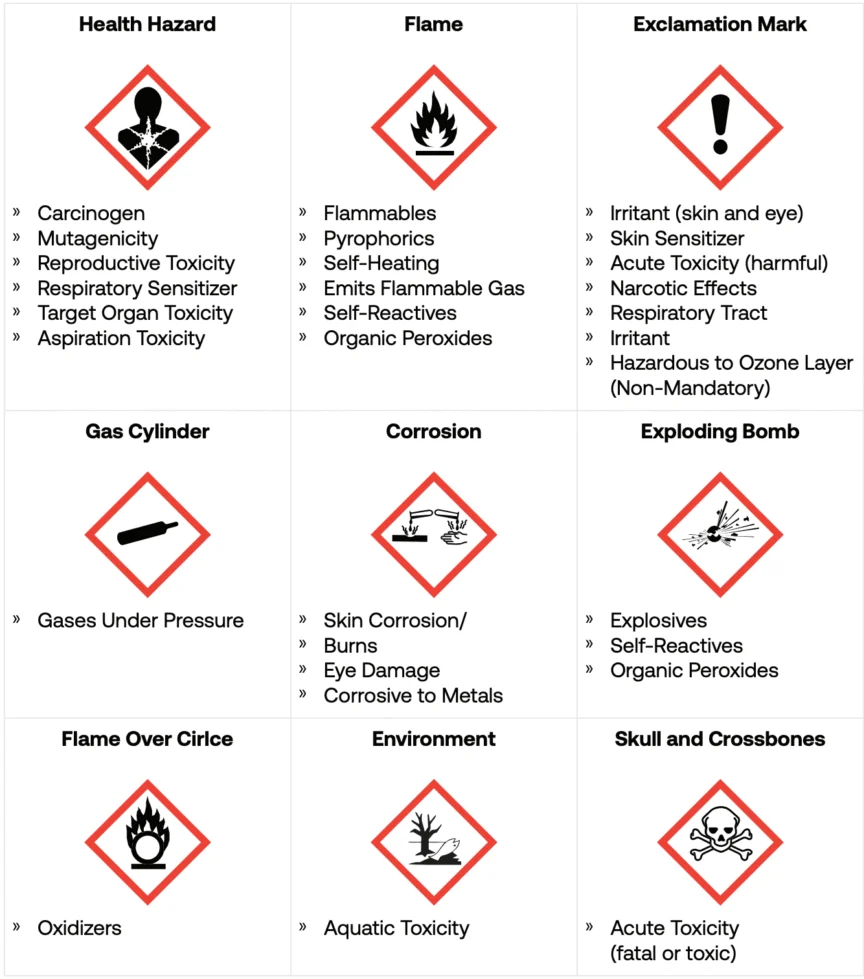
What OSHA looks for:
4. Maintain Safety Data Sheets
What is an SDS?
Chemical manufacturers and importers must obtain or develop a Safety Data Sheet (SDS) for each hazardous chemical they produce or import, and employers must maintain an SDS for each hazardous chemical they use. Employers must also ensure that these SDSs are readily accessible to employees.
The SDSs are the source of detailed information on hazardous chemicals. This includes information for many different audiences: employers, employees, safety and health professionals, emergency responders, government agencies, and consumers. The information of immediate use to exposed workers and emergency responders is at the beginning of the SDS, while the more technical information is located in the later sections.
Maintain a Safety Data Sheet for Each Hazardous
Chemicals
Employers must maintain the current version of the SDS. If you receive a hazardous chemical from a supplier or manufacturer without an SDS, request one as soon as possible. If the SDS received is inadequate (e.g., blank spaces), request a completed one from the manufacturer. If you receive a new SDS, you must maintain it and make it available to employees.
Keep SDSs Readily Available for Employees
Some employers keep the SDSs in a binder in a central location, while others provide access electronically. If you provide SDSs electronically, there must be an adequate backup system in place in case of a power outage, equipment failure, or other emergency involving the primary electronic system.
No matter what system is used, employers must ensure that employees and medical personnel can immediately obtain the required information in an emergency
What OSHA looks for:
5. Inform and Train
Inform Employees about Hazardous Chemicals in Their Work Areas
Paragraph (h) Employee Information and Training. Employers must train employees on the hazardous chemicals in their work area before initial assignment and when new hazards are introduced. It’s critical that workers understand they are exposed to hazardous chemicals, know how to read labels and SDSs, have a general understanding of the information provided, and know how to access related tools.
Employees must also be aware of the protective measures available to them, how to use or implement these measures, and whom to contact if an issue arises.
The HCS standard requires you to inform employees of:
Provide Training to Comply with the HCS
Training is a more active process. The training must be conducted to comply with the HCS
and must address the following:
A properly conducted training program will ensure worker comprehension and understanding. It’s not sufficient to just read material to the workers or simply hand them material to read.
What OSHA looks for:
6. Evaluate and Reassess Program
Review Your Hazard Communication Program Periodically
It will be necessary to periodically evaluate and reassess your hazard communication program to ensure it is still working and meeting its objectives:
Address Changed Conditions in the Workplace
Start with the list of hazardous chemicals maintained as part of your written program. That will serve as an inventory to ensure that SDSs for all chemicals in the workplace are on file and current:
Program managers should routinely walk around the workplace to check that containers are labeled as required and that employees follow established work practices to protect themselves from chemical exposure. Proactive monitoring of the workplace is critical to ensuring compliance with the HCS.
There are many areas where the hazard communication issues can be found. Check storage closets for chemical labeling, including janitor closets that may house chemicals that are not present in the rest of the facility. Review the documents to ensure signatures are current. Review training records to ensure employee training is completed, and check with the Program Manager to make sure the chemical inventory is up to date.
The Ultimate Checklist for HCS Compliance
In summary, ongoing compliance with the HCS can be straightforward when you take all the appropriate steps. Use the cheat sheet below to ensure that your internal hazard communication plan runs on all cylinders.
How Novara Helps Strengthen
Your Hazard Communication Program
Novara is here to help you maintain a comprehensive Hazard Communication program.
HazCom Written Program
Novara’s expert EHS consultants will help you develop a written program that is tailored to your business. It will include everything OSHA looks for including:
Hazard Communication Awareness Training
Novara also provides online and on-site Hazard Communication training. Courses for both employees and managers cover how information about hazardous materials is communicated in the workplace. They also include information about how to read hazard labels and safety data sheets as well as the importance of the written program and training.
SDS Management
Ensuring your employees have quick and easy access to Safety
Data Sheets may be the most important component of your Hazard
Communication program. With Novara Flex you have access to a database of over 70 million datasheets. You can create your own SDS folders and custom SDS library with an easy to search interface. You’ll also have offline access and hardcopies to ensure all your staff can easily find SDSs. Finally, you can print pre-populated secondary container labels for GHS compliance.

OSHA Top 10
OSHA citations. They’re rampant, they hide in plain sight, and they have potentially dire consequences for your people and your bottom line. OSHA citations. The OSHA Top 10 eBook contains explanations of each hazard, along with warning signs to look out for, and prevention checklists you can use to improve compliance and minimize losses.

Data to Decisions 2026 Benchmark Report
75% of EHS and ops leaders are not confident that their data would flag the next SIF. See what separates the confident 25% in Novara's 2026 benchmark report.

The Simplicity Imperative
Have you been hesitant to adopt Safety Software? Heres a clear and simple summary of essential information about it
Book A Demo
You can deliver exceptional EHS Programs with less effort. Contact us today.