The Hidden Risks of New Hires: Why Year One is Critical for Workplace Safety

Here’s a startling fact that should grab every safety professional’s attention: 34% of workplace injuries occur during an employee’s first year on the job. That’s right—one-third of all workplace injuries happen to your newest team members, according to the 2023 Travelers Injury Impact Report. This sobering statistic highlights a critical truth: every new hire represents both an opportunity and a potential risk to your safety culture.
Industry-Specific Risk Patterns
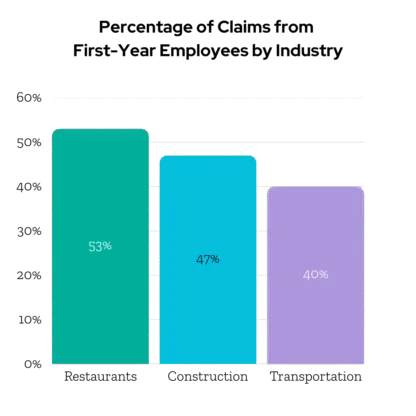
The risk isn’t uniform across industries. Some sectors face particularly steep challenges when it comes to first-year employee safety, as shown in the chart below. Restaurants lead the way with over half of their claims coming from first-year employees, while construction and transportation sectors also show concerningly high percentages. These numbers paint a clear picture: industries with complex operational procedures and high-risk activities need to pay special attention to new hire safety.
Even more concerning is the trend over the past decade. Across multiple sectors—from nonprofits and educational institutions to manufacturing and professional services—there’s been roughly a 10% increase in workers’ compensation claims filed by first-year employees.
When we discussed this topic with our customers in the Novara Connect customer community, we discovered a wide range of industry-specific challenges contributing to these statistics.
Taylor Marshall, Safety & Environment Manager at KONE, explains the challenge in the elevator industry:
“It’s extremely dangerous. We can’t just hire anyone. They must be accepted to school to become an apprentice and work for 4-5 years before they can be a mechanic.”
This highlights how some industries have recognized the high stakes involved with new employees and have implemented long apprenticeship periods to address safety concerns.
Why Are New Hires Particularly Vulnerable?
The vulnerability of new employees stems from a combination of operational and human factors that create a perfect storm of risk. At its core, the issue often comes down to one simple truth: they don’t know what they don’t know.
As Chris Gafford, EHS Manager at Ring Energy, explains:
“Oil and Gas is dangerous…especially for young workers that have spent their lives indoors playing video games. They are now exposed to not only the hazards of large, heavy, moving equipment, but also things as simple as the elements. Believe it or not, we see lots of short service employees suffering heat stress injuries simply because they aren’t acclimated to working outdoors.”
Let’s break down the key risk factors:
Operational Gaps
These aren’t just theoretical concerns—they’re real challenges that safety professionals encounter daily.
Madison Durade, EHS Specialist at Ram Aviation Space & Defense, notes:
“Some of the most challenging risks to address include Lockout/Tagout (LOTO) compliance to prevent accidental machine startups, safe navigation around Powered Industrial Vehicles (PIVs) such as forklifts, and ensuring the consistent use of Personal Protective Equipment (PPE).”
Here are common gaps we see in organizations across industries:
- Insufficient orientation and training processes:
For example, handing a new hire a safety manual without proper walkthrough or hands-on demonstration - Lack of site-specific training components:
Missing crucial details like where to find safety data sheets (SDS) or the location of emergency assembly areas - Inadequate preparation for job-specific hazards:
Such as proper procedures for changing propane cylinders on forklifts or operating specific machinery - Limited accountability measures:
Failing to have structured evaluation checkpoints during the first year or regular safety performance reviews - Incomplete understanding of safety protocols:
Like not knowing when to use personal protective equipment (PPE) or proper emergency response procedures
David Pomaville of Caglia Environmental learned this lesson after addressing a propane cylinder burn injury:
“We modified our evaluation tool and then implemented an inspection process to verify compliance.”
This systematic approach—combining training, evaluation, and verification—shows how operational gaps can be effectively addressed.
Cultural Factors
Perhaps more dangerous than operational gaps are the cultural factors that put new hires at risk:
- The “eager to please” or “superhero” mentality, where new employees push themselves beyond safe limits to prove their worth
- A culture of assumptions, where veterans assume new hires understand basic safety protocols
- The pressure of production over safety, especially when trying to prove oneself
- The presence of “coyotes”—experienced workers who may encourage taking shortcuts
- General workplace complacency that can influence new hires’ behavior
Garett Cornwell, Safety Director at a roofing company, highlights one persistent cultural challenge:
“Construction work is still ‘macho’; new guys will do things they aren’t comfortable with or that they think is unsafe if others are doing it.”
Timothy Shaw, Information Success Coordinator at McCumber Well Service, emphasizes the importance of team dynamics:
“While there are plenty of inherent risks in our field, I think the biggest one is the dynamics within the crews themselves. If they aren’t all on board with watching out for the new hires and ensuring each task is done safely and correctly while transferring the knowledge of why it is being done that way, we are just setting ourselves up for a future failure.”
How Novara Can Help
Understanding these risks is just the first step. The real challenge lies in implementing effective solutions that protect your new hires from day one. That’s where Novara’s comprehensive approach makes a difference.
As Bill Woods, Director of Safety, Quality and Regulatory Compliance at American Welding & Gas, shares:
“We provide a combination of specific computer-based training along with on-the-job training.”
For many companies, this blended approach provides the foundation needed to address both knowledge gaps and practical application challenges.
David Finley, HSE Director at Dolese, puts it plainly:
“We work in a high-risk environment every day. We are drilling, blasting, mining, and moving heavy materials all day everyday at each location. Teaching a new hire about all the potential hazards and risks takes much more than a few solid days of orientation.”
Novara’s integrated safety solutions help you address these challenges through:
- EHS Software:
Our flexible platform allows you to establish and implement a comprehensive safety program specifically tailored to new employees. Track training completion, conduct targeted assessments, and monitor safety metrics by employee tenure. - Expert Consulting:
Our experienced risk management consultants can help you identify potential gaps in your onboarding process and recommend preventive actions designed specifically for new hire safety. - Award-Winning Training:
Novara offers comprehensive online training courses based on real-world scenarios that new employees are likely to encounter, helping them improve on-the-job performance from their very first day.
Take Action Now
Ready to protect your new hires and strengthen your safety culture? Novara’s comprehensive solutions can help you:
- Evaluate your current onboarding process
- Identify potential safety gaps
- Implement proven strategies for new hire safety
- Create a culture of safety from day one
Don’t let your new hires become statistics. Partner with Novara today to build a stronger safety culture that protects every employee from their very first day on the job.