Forklift Inspection Checklist
Learn how to prevent forklift workplace accidents with this helpful checklist.
Why Forklift Safety Matters
Powered industrial trucks, commonly known as forklifts, are essential equipment. However, they also represent one of the most significant safety hazards in the workplace when not properly maintained and operated. Weighing thousands of pounds and moving at high speeds, even a small mistake can have serious consequences.
What happens when a forklift’s brakes fail in the middle of a busy warehouse? Or when a faulty hydraulic system gives out while lifting a heavy load? These aren’t just “what if” scenarios; they’re real risks that come with operating them . That’s why forklift inspections aren’t just another checkbox on a safety form; they’re the frontline defense against accidents, injuries, and costly downtime . No matter how much you know (or think you know) about the most common workplace violations out there, it’s clear that organizations could use some help .
OSHA Quick Stats
According to OSHA, forklift-related accidents result in approximately 34,900 serious injuries and 85 fatalities annually. Many of these incidents could be prevented through proper daily inspections and maintenance.
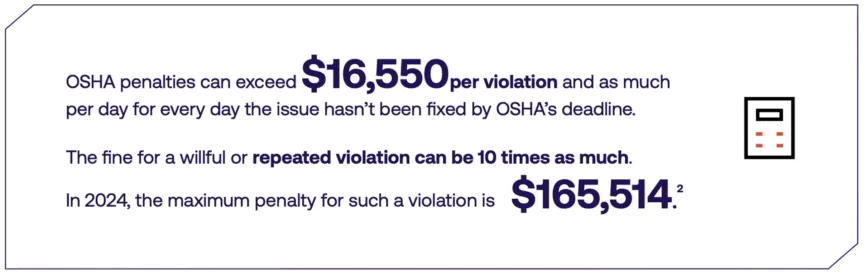
And those are just the direct costs. Organizations that don’t adequately address common workplace hazards can expect to pay hundreds of thousands—even millions—in indirect expenses.
Of course, the true costs of a safety violation are incalculable. No one can put a number on an employee’s life. Suffice it to say, it’s in your organization’s best interest to bring your annual number of injuries and illnesses to zero.
Fortunately, avoiding an OSHA citation isn’t as complex or cost-intensive as many people think. Small steps can save you 6 or 7 figures—or even save someone’s life.
Examples of indirect workplace hazards expenses
The OSHA Standard
OSHA definition: “Powered industrial trucks, commonly called forklifts or lift trucks, are used in many industries, primarily to move materials. They can be used to move, raise, lower, or remove large objects or a number of smaller objects on pallets or in boxes, crates, or other containers. The hazards commonly associated with powered industrial trucks vary depending on the vehicle type and the workplace where the truck is used. Each type of truck presents different operating hazards. For example, a sit-down, counterbalanced high lift rider truck is more likely than a motorized hand truck to be involved in a falling load accident, because the sit-down rider truck can lift a load much higher than a hand truck. Workplace conditions also present different hazards. For example, retail establishments often face greater challenges than other worksites in maintaining pedestrian safety..”11
Simple definition: Countless businesses rely on forklifts, which OSHA likes to call “powered industrial trucks,” to move large/heavy objects. However, the things that make forklifts useful also make them dangerous. Loads can fall and crush people. Forklifts can tip over, injuring drivers and workers nearby. Pedestrians can get hit, which is especially common in workplaces where a lot of people are moving around on foot.
OSHA’s forklift rules cover issues such as the following:
For OSHA’s full list of standards, visit www.osha.gov/SLTC/poweredindustrialtrucks/standards.html.
Why Violations Happen
There are two primary kinds of forklift-related accidents.
The first is when forklifts tip over. Often, this is due to balancing issues. Other times, it happens when forklifts are driven too fast—the forklift turns too quickly, or hits an obstacle, and the operator loses control.
The second leading cause of forklift violations are pedestrian accidents. Perhaps a forklift operator doesn’t see a pedestrian, or a pedestrian isn’t paying attention and walks in front of a forklift. Sometimes, a load falls or a forklift tips over and strikes a bystander. Other times, pedestrians may be injured or killed by a forklift falling off a loading dock, or when they themselves fall from an elevated pallet or tine (the “arm” of a forklift).
Keep in mind that it’s illegal for anyone under 18 years old to operate a forklift.
Signs You’re at Risk
Forklift Violation Prevention Checklist
Daily Forklift Inspection Checklist
| Operator Name: |
| Date/Time: |
| Forklift Model/Serial#: |
| Hour Meter Reading: |
| Visual Inspection – Engine OfF | YES/no |
|---|---|
| Tires: Check for wear, damage, proper inflation, and secure mounting | |
| Forks: Inspect for cracks, bends, or excessive wear at heel and mounting | |
| Mast and Chains: Check for damaged links, proper lubrication, and equal tension | |
| Hydraulic System: Look for leaks, damaged hoses, and proper fluid levels | |
| Battery (Electric): Check water level, cable connections, and restraint system | |
| Engine Fluids (IC): Oil, coolant, transmission fluid at proper levels | |
| Safety Equipment: Fire extinguisher present and charged, seat belt functional | |
| Data Plate: Legible and matches forklift configuration | |
| Overhead Guard: Securely mounted, no cracks or damage | |
| Load Backrest: Properly attached and undamaged | |
| Visual Inspection Notes: |
| Visual Inspection – Engine Running | YES/no |
|---|---|
| Steering: Smooth operation, no excessive play or binding | |
| Service Brakes: Test stopping ability, no grabbing or pulling | |
| Parking Brake: Holds forklift securely on incline | |
| Horn: Loud and clear warning signal | |
| Lights: Headlights, tail lights, and warning lights functional | |
| Backup Alarm: Audible warning when in reverse | |
| Lift Controls: Smooth raising/lowering, no drift or jerky movement | |
| Tilt Controls: Forward and back tilt operate smoothly | |
| Attachment Controls: Side shift or other attachments function properly | |
| Gauges/Indicators: All readings within normal operating range | |
| Unusual Noises: No grinding, knocking, or squealing sounds | |
| Operational Test Notes: |
| Housekeeping & Final Checks | Yes/no |
|---|---|
| Operator compartment clean and free of debris | |
| No loose tools or materials that could fall or interfere with operation | |
| Operator’s manual present in designated holder |
I certify that I have performed the required inspection and that any defects have been reported to maintenance .
Operator Signature:
Date:
Forklift Safety Made Easy with Novara
Forklift inspections are crucial for workplace safety, preventing accidents and ensuring compliance with OSHA regulations. They lead to fewer breakdowns and injuries fostering a culture of safety.
However, managing daily, weekly, and annual inspections can be challenging, with paper checklists piling up and compliance demands increasing .
Our safety solutions offer a more efficient approach, allowing teams to complete inspections quickly, document issues in real time, and address maintenance needs before they escalate . This smarter system helps keep your fleet safe while meeting regulatory requirements more effectively.
Couple this with a full library of forklift safety training courses to ensure operators are up to speed on safe practices .
Novara’s unique combination of software, training, and services can provide the coverage your people and your organization need .
Create and Deliver Engaging Training Content
Does your training content catch your employees attention? Use this guide to create content they will engage with and remember.
10 Questions to Measure Employee Engagement in Your Safety Program
Use this list of questions to determine your employees's feel empowered to uphold workplace safety
The Sure-Fire Guide to Fire Extinguisher Inspections
While we hope that fire extinguishers never have to be used, they still need to be inspected and maintained to ensure they are working properly in case an emergency occurs.
Book A Demo
You can deliver exceptional EHS Programs with less effort. Contact us today.