The Safety Metric Challenge: Transforming KPI Tracking for Real Results

In the complex landscape of workplace safety, effectively tracking and measuring safety metrics is crucial for maintaining a robust safety program. Yet, a recent Novara survey has uncovered a startling reality: an overwhelming majority of safety professionals are grappling with significant challenges in this critical process.
From difficulties tracking performance against established KPIs to struggling with fragmented data management systems, these obstacles are far more widespread than many might expect. As we delve into these challenges, we’ll explore not just the problems but also practical solutions that can transform your safety metrics from a source of frustration into a powerful tool for improvement.
Challenges in Tracking and Measuring KPIs
Our survey revealed significant challenges that safety professionals face when it comes to effectively tracking and measuring safety performance.
Let’s break down these challenges into two key areas: the difficulty of tracking KPIs and the complexity of data management systems.

About the Survey
In partnership with EHS Daily Advisor, our recent survey gathered valuable data from 110 industry leaders, safety officers, and employees, shedding light on the most effective KPIs and their impact on workplace safety.
Difficulty in Tracking KPIs
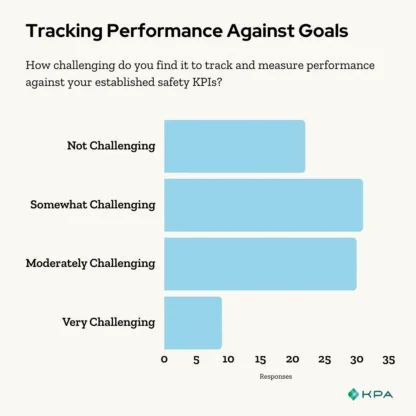
The survey results highlight a concerning trend in the ability of organizations to track their safety KPIs effectively:
- 74% of respondents find it challenging to track and measure performance against established safety KPIs
- 10% find it very challenging.
These statistics indicate that nearly three-quarters of safety professionals face some level of difficulty in tracking and measuring their safety performance. This challenge can lead to ineffective safety programs, missed opportunities for improvement, and potential increased risk of workplace incidents.
The Takeaway
For safety managers struggling with KPI tracking, the key is to simplify and streamline your processes. Start by reviewing your current KPIs and ensuring they align with the SMART criteria (Specific, Measurable, Achievable, Relevant, and Time-bound). Consider implementing a user-friendly EHS software solution that automates data collection and reporting. This can significantly reduce the time and effort required to track KPIs, allowing you to focus on analyzing trends and implementing improvements. Remember, the goal is not just to track metrics, but to use them effectively to drive safety improvements.
Novara’s recent survey of safety professionals reveals interesting insights into how organizations approach safety metrics and where there’s room for growth.

Complexity of Data Management Systems
Another significant challenge revealed by our survey is the complexity of systems used to manage safety data:
- Most safety managers (62%, to be precise) do not have easy access to their data in one system.
- 34% of organizations rely on three or more systems to gather necessary data for tracking KPIs.
This fragmentation of data across multiple systems creates several inefficiencies and challenges for safety managers.
The Takeaway
The prevalence of multiple systems and siloed data presents several challenges for safety managers:

- Time-consuming data collection:
Safety professionals spend valuable time gathering data from various sources instead of analyzing and acting on insights. - Inconsistent reporting:
Different systems may use varying definitions or calculation methods, leading to inconsistencies in KPI reporting. - Delayed decision-making:
With data spread across multiple platforms, compiling comprehensive reports can take days or weeks, delaying critical safety decisions. - Limited data visibility:
Siloed systems often restrict access to certain stakeholders, hindering organization-wide safety awareness and collaboration. - Increased risk of errors:
Manual data transfer between systems increases the likelihood of human error, potentially compromising the accuracy of safety metrics.
These inefficiencies not only impact the effectiveness of safety programs but also increase the workload on safety professionals, taking time away from critical tasks like hazard identification and mitigation.
If your organization is using multiple systems to manage safety data, it’s time to consider consolidation. The ideal solution is to move towards a single, integrated EHS management system. This not only simplifies data collection and reporting but also ensures consistency across your safety metrics. In the short term, if a complete system overhaul isn’t feasible, look for ways to better integrate your existing systems. This could involve using data integration tools or creating standardized processes for data transfer between systems. The goal should be to reduce manual data entry, minimize the risk of errors, and create a more holistic view of your safety performance.
Here’s What Novara Customers Say
“Tracking lost work days, immediate entries, and less time working inside the system. We were able to show all of these as an ROI.”
– Tonya Acred, WC System Specialist, TK Elevator
“Novara presented the company with a uniform, unified reporting and management conduit that significantly reduced the latency in reporting. My labor hours as Management have been reduced by as much as an entire workday.”
– EHS Director
Beyond Metrics: Building a Safer Workplace Through Better Data
The challenges of tracking and measuring safety KPIs are significant but not insurmountable. By simplifying processes, consolidating data systems, and leveraging modern EHS software solutions, safety managers can overcome these hurdles and unlock the full potential of their safety metrics. The benefits are clear: reduced reporting latency, saved management time, and most importantly, a more effective safety program. Remember, the goal isn’t just to track metrics, but to use them effectively to drive real safety improvements. Take the first step today towards streamlining your KPI tracking process – your future self, and your workforce, will thank you for it. In the world of workplace safety, better data management doesn’t just mean better metrics – it means safer employees and a stronger organization.
Monitoring Safety Program Metrics is easier with solid EHS software in your team’s hands.
Novara simplifies data visualization and reporting, giving users easy access to actionable insights into their EHS program performance. Your data is presented in real-time, so no delay or extra steps are required to access the information. The dashboards are configured based on features tailored to your business’s unique requirements, giving you the power to make informed decisions that impact workplace safety.
Let Novara show you how to take a data-driven approach to safety.
Novara’s recent survey of safety professionals reveals interesting insights into how organizations approach safety metrics and where there’s room for growth.