A Safety Platform Can Only See What Your Frontline Reports

The metrics can be right and the picture can still be wrong. If most of your frontline isn’t reporting, what your dashboard shows you is a portrait of whoever happened to log in, not your operation.
Most programs never run this math: when a small slice of your workforce files most of your near-miss reports, your dashboard ends up showing you that slice, dressed up as the whole operation. Call it a sampling problem, one that’s been sitting in plain sight in a lot of programs for years, disguised as a working dashboard.
A better chart won’t fix this. The people closest to the risk need an easier way to get a signal into the system.
Two Versions of the Same Problem
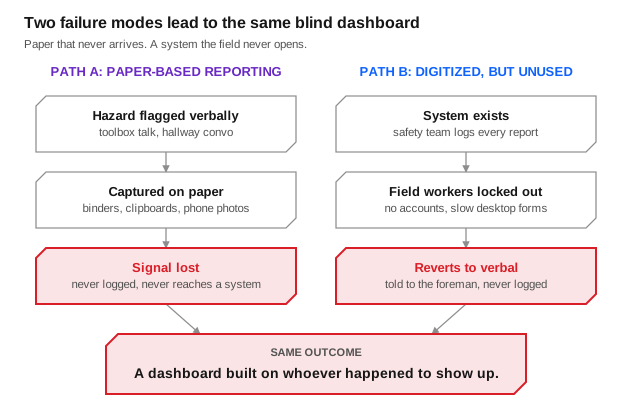
However a program got here, the result looks the same: the signal never leaves the field.
Programs still living in binders, clipboards, and photos in your inbox lose that signal before it ever reaches a system.
A hazard mentioned at a toolbox talk and never logged doesn’t show up as a false negative. It doesn’t show up anywhere a dashboard can find it. That’s not because the crew doesn’t care. It’s because the reporting mechanism asks more of the person closest to the risk than it gives back — a form to track down, a supervisor to catch between tasks, a system that lives somewhere else.
The system exists. But only the safety team logs in.
Contractors never get accounts. Field workers open the app once, hit a slow form that was built for a desktop screen, and go back to telling their foreman verbally, like they always have. Digitizing the safety team’s side of the process doesn’t close the gap. It just moves the paper problem into a system nobody in the field actually uses.
Most Programs Hear from Less Than Half Their Frontline
The 2026 Decision Gap benchmark, a survey of EHS and operations leaders, put a number on this.
Under 25% of frontline workers engage with the reporting program in a typical month at 32% of programs. Another 26% sit between 25% and 50%. Only 22% see more than three-quarters of their frontline reporting regularly.
Add it up: 58% of programs hear from less than half their frontline in a typical month. At that scale, this is simply how the industry runs.
The same report found something worth thinking about. Confidence in predicting serious injuries and fatalities jumps once frontline engagement crosses 25%, climbing from 41% confident to 56%. Then it plateaus. Grinding from a quarter of the workforce reporting to three-quarters mostly doesn’t move that number on its own. Confidence doesn’t jump again until participation clears 75%, where it hits 81%. Partial adoption buys partial confidence. The real gain sits at the top, in getting reporting close to universal.
Where the Gap Actually Lives
Ask leaders what’s standing in the way, and the answer isn’t subtle. Frontline workers not engaging with the program is the single largest obstacle named in the Decision Gap survey, at 29%. Disconnected systems come in at 17%.
Put those two together and you get the shape of the problem. The people who see the risk first aren’t in a position to get it into the system easily. And the systems that do exist don’t talk to each other, so even the reports that make it in don’t add up to a full picture.
The Signals You’re Missing Right Now
None of this shows up as an error message. It shows up as silence. A few things that silence is hiding:
The near-miss mentioned out loud and never logged
A toolbox talk, a verbal handoff, a “yeah, watch that ladder” that goes nowhere.
The precursor a foreman notices and fixes on the spot
No incident happens, so nothing gets recorded. But it’s a genuine SIF precursor by any definition that matters — a condition or near-miss signature that shows up before a serious injury or fatality, whether or not anyone got hurt that day.
The repeat condition across sites that nobody sees
This training covers what Naloxone is and its relevance to the workplace. It covers warning signs, risk assessment, training, and personal protective equipment.
A citation checklist records what an inspector found on a walkthrough
It was never built to catch what a foreman notices mid-shift. That’s a different kind of signal, and it needs a different kind of front door to reach anyone at all.
A New Front Door, Not a New Metric Set
The fix here has nothing to do with another dashboard or another KPI. What actually moves the needle is making it easier for the person closest to the risk to get a signal into the system in the first place.
The Decision Gap report puts it plainly: “A solid dashboard fed by the whole operation outperforms a sophisticated one fed by partial data. The constraint on prediction isn’t model quality. It’s how much of the operation reports in.”
Read that twice. It’s the whole argument in two sentences. That line implies something most programs haven’t fully absorbed. Participation is the precondition for the analysis, not a footnote sitting beside it. A basic system used by everyone beats a sophisticated one used by a fraction of the workforce, every time.
Adoption is the analysis strategy. Everything else is downstream of that.
What a Frontline-Facing Form Actually Needs
None of this is complicated. It just takes discipline to hold the line on it once budgets and feature requests start pulling in other directions.
The goal is forms the field will actually fill out. Not forms that win design awards.
Miss one of these, and the form joins the pile of tools nobody actually uses in the field.
Speed
Input in seconds, not minutes — with gloves on, truck idling, mid-shift.
Mobile
Built for a phone screen and spotty signal, not a desktop form shrunk down to fit.
In the right language
Native-language support isn’t an accessibility footnote. For a field-heavy, contractor-dense workforce, it’s a participation requirement.
Consistency
Same event categories and severity definitions across every site. Otherwise the data that does come in can’t be compared or aggregated, and the disconnected-systems obstacle shows back up in a different shape.
Five Moves to Fix the Input Layer in 30 Days
None of this requires a new system. It requires paying closer attention to the one you’ve already got.
- Audit which sites and contractor crews have zero logins or zero submissions in the last 30 days.
- Cut the reporting form down to the fields that are actually used in a decision, nothing else.
- Put reporting on the device people already carry, not a shared kiosk or desktop.
- Standardize severity and event categories across every site before adding anything new to track.
- Close the loop visibly. Tell the person who reported something what happened next, even briefly.
What This Means for the Budget Conversation
More complete frontline reporting tends to show up, a year or so later, as fewer serious incidents and better terms at renewal. That’s the version of this argument that reaches a CFO — not a better dashboard, a lower loss ratio.
“We’re seeing a significant reduction [in accidents and injuries], so much that we are one of the top ten members of our captive insurance group that is being recognized for our enhanced safety performance.”
– Bart Miller, Director of EH&S, Mt. Diablo Resource Recovery
The Precursors Already Exist
They’re not missing. They’re just not making it from the floor into your system — and no dashboard, however well built, fixes that from the top down. Adoption comes first. The analytics only start earning their keep once the frontline is actually reporting.
That’s the gap Novara is built to close. Not another layer of charts on top of the same thin data — a reporting experience the field will actually use: fast enough for gloves-on, mid-shift input, mobile instead of a shrunk-down desktop form, available in the language your crews actually speak, and consistent across sites so that what comes in can be compared and acted on.
Close that gap, and the safety platform you already run stops working from a sample and starts working from your actual operation. The precursors are already happening on your sites. The only open question is whether your systems are built to hear about them.
GET YOUR COPY
Get The Decision Gap: 2026 Benchmark
The Decision Gap is written for EHS leaders, operations leaders, and the executives who sign off on safety strategy in high-hazard industries: anyone accountable for the distance between a hazard someone reported and a decision someone made.
See the full breakdown of what separates confident safety programs from the rest — plus how Novara customers compare on every measure in the report.